At its peak in the late 1600s, the Mughal Empire was the largest and wealthiest empire on Earth — but it is remembered less for military power than for what it built: gardens, tombs, mosques, paintings and poetry that still define South Asia’s cultural landscape. From the Taj Mahal to the Badshahi Mosque, Mughal art is part of the daily visual world of millions today.
How the Empire Began
The Mughals were a Muslim dynasty of Mongol origin — “Mughal” comes from the Persian word for Mongol, and the word is the source of the English term “mogul.” The founder, Babur, was a descendant of both Genghis Khan and Timur (Tamerlane). In 1526, Babur defeated the Delhi Sultanate at the First Battle of Panipat and established the empire.
Babur’s grandson Akbar (r. 1556–1605) turned this military conquest into a functioning empire. He built an efficient administration, encouraged trade, and practised a notable religious tolerance — marrying a Rajput princess and bringing Hindu officials into his court. His capital cities, Agra and Fatehpur Sikri, became centres of learning and craft.
A Golden Age of Art and Architecture
The Taj Mahal: the jewel of Mughal art
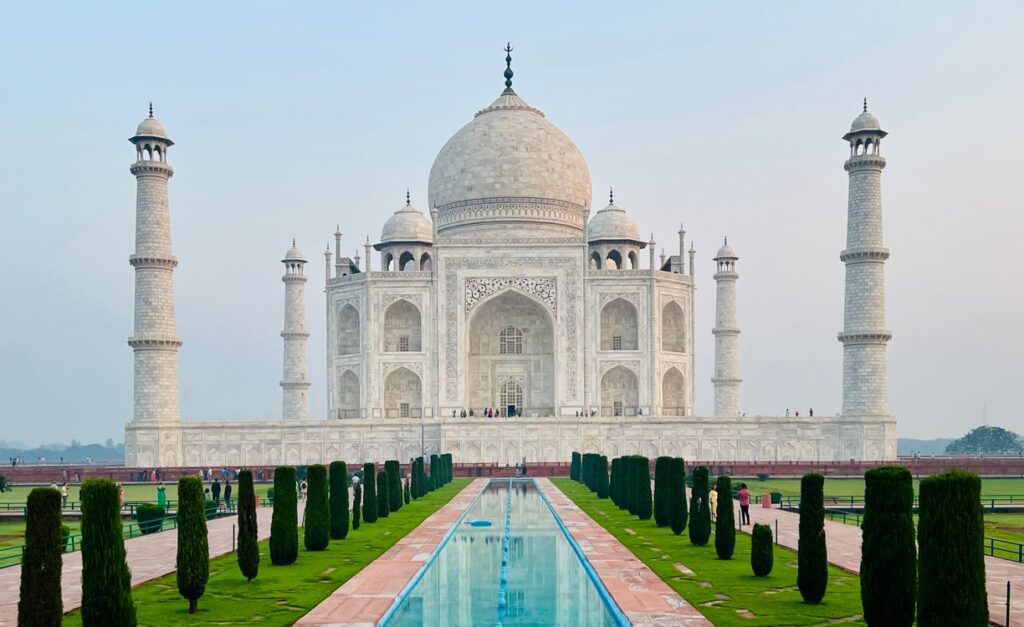
No discussion of Mughal art can avoid the Taj Mahal in Agra, commissioned by the fifth Mughal emperor Shah Jahan (r. 1628–58) to house the tomb of his wife Mumtaz Mahal, who died in childbirth in 1631. Construction began around 1632, employed some 20,000 artisans, and continued for roughly two decades.
Built of ivory-white marble inlaid with semi-precious stones, the Taj blends Indian, Persian and Islamic styles: a massive central dome, four slender minarets, perfect bilateral symmetry, calligraphic inscriptions, and the famous charbagh (four-part) Persian garden. It was designated a UNESCO World Heritage site in 1983 and remains, in UNESCO’s words, “the jewel of Muslim art in India.”
Other great monuments
- Humayun’s Tomb (Delhi) — the first great Mughal mausoleum, whose red sandstone and white marble set the template the Taj would later perfect.
- Agra Fort and the Red Fort (Delhi) — massive fort-palaces in red sandstone that doubled as seats of government and showcases of imperial splendour.
- Fatehpur Sikri — Akbar’s purpose-built capital, a city of palaces, courtyards and the towering Buland Darwaza gate.
- Badshahi Mosque (Lahore) — built under Aurangzeb, one of the largest mosques of its era and still an iconic symbol of Lahore.
- Shalimar Bagh (Srinagar) — the terraced Mughal gardens that introduced Persian garden design to Kashmir.
Painting, Literature and Music
Mughal creativity went far beyond stone. Emperor Jahangir (r. 1605–27), Shah Jahan’s father, was one of history’s great patrons of painting. His court workshops produced miniature paintings of remarkable naturalism — portraits, hunting scenes, and botanical studies of animals and plants painted with scientific care.
The court language was Persian, and Mughal emperors were themselves authors: Babur wrote the Baburnama, a candid autobiography that remains one of the great memoirs of world literature, while later rulers commissioned vast illustrated chronicles such as the Akbarnama. Music and dance flourished at court, laying foundations for the Hindustani classical tradition.
Administration and Everyday Legacy
The Mughals were skilled administrators and traders. Their revenue system, road networks and standardised coinage integrated a subcontinent of many languages and faiths. Words we use daily — darbar, kachehri, zamindar, sarkar — come from Mughal administration. So does much of the food: biryani, kebabs, korma, and the rich slow-cooked cuisine of the region carry Persian-Central Asian techniques fused with local ingredients.
Urdu itself grew in the Mughal world, emerging as a language of the camps, courts and cities of the empire before becoming the literary language of Ghalib and Iqbal. When students today read Urdu poetry or eat pulao, they are touching Mughal legacy directly.
Decline and the End of Empire
After Aurangzeb’s long reign ended in 1707, the empire weakened under succession wars, regional rebellions and British colonial pressure. In 1857, the British exiled the last emperor, Bahadur Shah Zafar, to Rangoon — ending more than three centuries of rule. But while the empire fell, its art endured.
Conclusion
The Mughal Empire matters not because of the size of its armies but because of what its artists and builders left behind — a fusion of Persian, Central Asian and Indian traditions that still shapes the architecture, language, cuisine and art of Pakistan and India. For students of history, the Mughals are a perfect case study in how culture outlives power: empires fall, but a well-built idea — or a well-built dome — can last forever.
References
- Britannica — Taj Mahal: history, architecture and facts
- National Geographic — A Husband’s Love Built the Taj Mahal
- Google Arts & Culture — Taj Mahal: construction, artisans and UNESCO status
#MughalEmpire #History #Architecture #Culture #Heritage
