For more than six centuries, the Ottoman Empire stood at the crossroads of Europe and Asia, ruling lands that today span over thirty countries. Founded by Turkish tribesmen in Anatolia, it grew into one of history’s most powerful and culturally rich empires. Its palaces, mosques, and laws still shape the modern Middle East and Balkans — which is why every student of history should understand its story.
The Rise: From Frontier Principality to World Power
Osman’s Dream and Early Expansion
The empire takes its name from Osman I, a 13th-century leader of a small Turkish principality in northwestern Anatolia. His successors were brilliant opportunists: as the Byzantine Empire weakened, Ottoman armies captured Bursa, Adrianople, and eventually — in 1453 — Constantinople itself. Sultan Mehmed II’s conquest of the city ended a thousand years of Byzantine rule and made Istanbul the Ottoman capital, a seat of power between two continents.
The Age of Suleiman the Magnificent
The empire reached its zenith in the 16th century under Suleiman the Magnificent (r. 1520–1566). Ottoman armies pushed to the gates of Vienna, the navy dominated the Mediterranean, and the empire controlled the holy cities of Mecca and Medina. But Suleiman’s true title, “Kanuni” (the Lawgiver), reflects his greatest achievement: a sophisticated legal system that harmonized Islamic law with centuries of sultanic decrees, governing a multi-ethnic, multi-religious population with remarkable stability.
A Civilization, Not Just an Empire
Architecture That Still Defines Istanbul
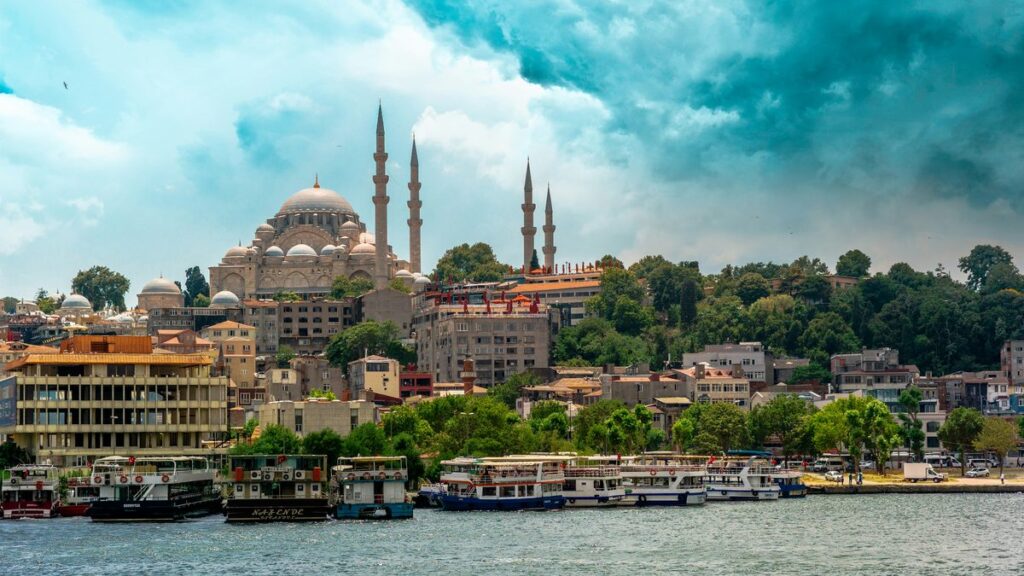
Walk through Istanbul today and you walk through Ottoman history. The architect Mimar Sinan, the empire’s chief builder for fifty years, designed masterpieces like the Süleymaniye and Selimiye mosques — vast domed spaces engineered with a precision that rivaled anything in Renaissance Europe. Ottoman architects perfected the great dome-and-minaret silhouette that remains the visual signature of the Islamic world’s great cities.
Art, Food, and Daily Life
The Topkapi Palace was not only a seat of government but a center of art: illuminated manuscripts, Iznik ceramics, and silk textiles reached extraordinary refinement under court patronage. Ottoman cuisine — the kebab, baklava, stuffed vegetables, and the coffeehouse culture itself — spread from the palace kitchens across the empire and into Europe. Coffee, the drink that fueled the Enlightenment’s debates, arrived in the West through Ottoman trade.
The Millet System: Governing Diversity
Long before modern multiculturalism, the Ottomans managed religious diversity through the millet system: Christians and Jews were organized into self-governing communities that ran their own schools, courts, and charities under their religious leaders. It was not equality as we understand it today, but it allowed Greeks, Armenians, Jews, and others to preserve their identities for centuries — a pragmatic tolerance that helped the empire endure.
Decline and Enduring Legacy
From the 18th century onward, the empire fell behind industrializing Europe, losing territory through a series of wars until World War I proved fatal. In 1922 the sultanate was abolished, and Mustafa Kemal Atatürk founded the Republic of Turkey from the empire’s Anatolian heartland. But the Ottoman legacy endures: in the cuisines of the Balkans and the Middle East, in the skylines of Istanbul and Sarajevo, in legal traditions, and in the borders of modern nations drawn from its provinces. To understand today’s Middle East, you must first understand the empire that shaped it.
References
#History #OttomanEmpire #Culture #Civilization
