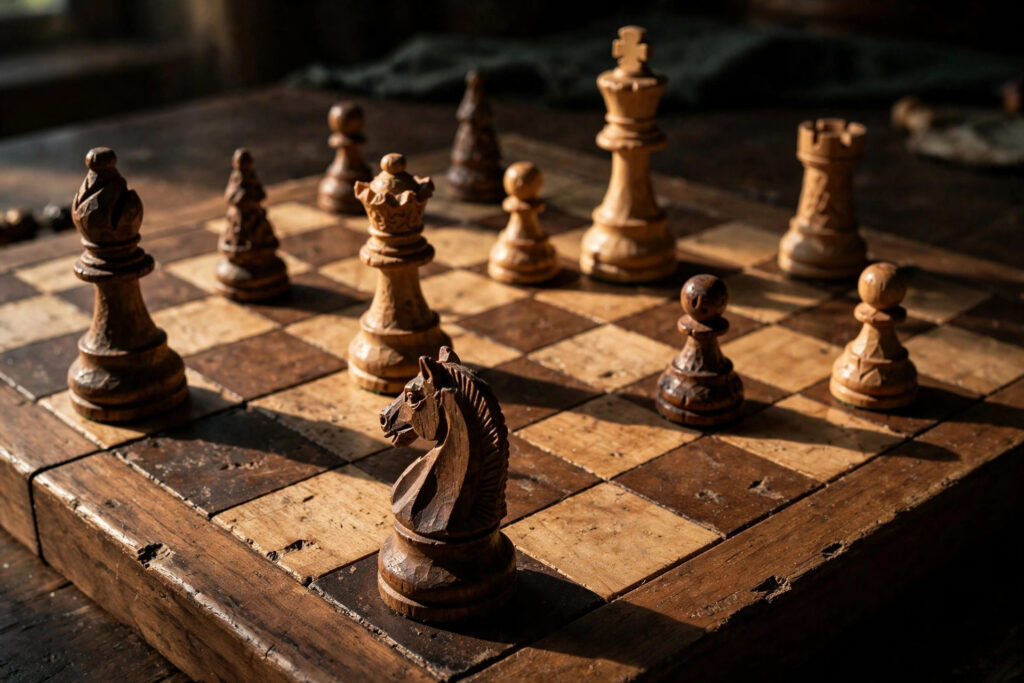
Chess looks intimidating when you watch two players thinking silently for hours, but the basics are surprisingly simple. To learn chess, you only need to understand how six kinds of pieces move, a few special rules, and what winning actually means. Everything else builds from there.
This guide walks you through the complete rulebook in plain language, then gives you practical tips for your very first games. The official rules are published by FIDE (the International Chess Federation) in its Laws of Chess, and the mechanics below follow them. Free interactive lessons are available at chess.com’s learn section and lichess.org’s Learn menu, which let you practice every rule against a friendly interface.
Set Up the Board Correctly
A chessboard has 64 squares in an 8×8 grid, alternating light and dark. Before you learn chess strategy, get the setup right: place the board so that each player has a light-colored square in their right-hand corner. Remember the rhyme “white on right.”
Each player starts with 16 pieces: one king, one queen, two rooks, two knights, two bishops, and eight pawns. Pawns fill the entire second rank (the row closest to each player). Behind them, the back rank is arranged from the corner inward: rook, knight, bishop, queen, king, bishop, knight, rook.
The queen always starts on a square matching her own color — the white queen on a light square, the black queen on a dark one. White moves first, and players then alternate one move each.
How the Pieces Move: The First Step to Learn Chess
Every piece except the knight moves in a straight line and cannot jump over other pieces. Captures work the same as moves: you take an opponent’s piece by landing on its square.
The king moves one square in any direction. He is the most important piece on the board but one of the weakest in power, so keeping him safe is central to the game. The queen is the most powerful piece, moving any number of squares horizontally, vertically, or diagonally.
Rooks move any number of squares horizontally or vertically, like a plus sign. Bishops move any number of squares diagonally, like an X — and each bishop stays on its original color for the entire game.
Knights are the oddballs: they move in an L-shape, two squares in one direction and one to the side. They are the only piece that can jump over other pieces, which makes them tricky and valuable in crowded positions.
Pawns move one square straight forward, but capture one square diagonally forward. On its very first move, a pawn may advance two squares instead of one. Pawns never move backward, so every pawn push is a permanent commitment.
Special Moves Every Beginner Should Know
Three special rules surprise almost every new player. First is castling: if neither your king nor the rook you are castling with has moved yet, the squares between them are empty, and your king is not in check or passing through attacked squares, you can move the king two squares toward the rook and place the rook on the square the king skipped. It is the only move that moves two pieces at once, and it is the fastest way to tuck your king into safety.
Second is en passant: if an enemy pawn advances two squares and lands beside your pawn, you may capture it as if it had moved only one square — but only on the very next move. This rule exists to stop pawns from dodging capture.
Third is promotion: when a pawn reaches the far side of the board, it must be exchanged for a queen, rook, bishop, or knight of your color. Most players promote to a queen. You do not need a captured piece to promote; in rare games a player can end up with two queens.
Check, Checkmate, and Stalemate
To win at chess, you must checkmate the enemy king. When your king is attacked, it is “in check,” and you must get out of check on your next move — by moving the king, capturing the attacker, or blocking the attack.
Checkmate happens when the king is in check and no legal move can escape it. That ends the game immediately; you do not actually capture the king.
There are also draws. Stalemate — when the player to move has no legal moves but is not in check — is a draw. So are draws by insufficient material, threefold repetition, the fifty-move rule, and mutual agreement. Beginners often stumble into stalemate by accident, so always check whether your opponent has any legal move before delivering what you think is mate.
Opening Principles: Your First Moves
The opening is the first 10 to 15 moves, and strong principles matter far more than memorizing sequences. First, control the center with pawns: classic first moves like 1. e4 (king’s pawn to e4) or 1. d4 (queen’s pawn to d4) open lines for your pieces. Openings taught in beginner courses, such as the Italian Game and the Ruy Lopez, all start this way.
Second, develop your knights and bishops toward the center rather than moving the same piece twice. Third, castle early — usually by move 7 to 10 — to connect your rooks and secure your king. Fourth, do not bring the queen out too early; she becomes a target for enemy minor pieces. Fifth, do not push too many pawns; every pawn move creates a permanent weakness behind it.
Common Mistakes Beginners Make
The most famous blunder is the Scholar’s Mate: 1. e4 e5 2. Qh5 Nc6 3. Bc4 Nf6 4. Qxf7 checkmate. It works against absolute beginners, but one sensible defensive move defeats it — so do not build your game around trick openings. Learn the ideas, not the traps.
Other classic mistakes include hanging pieces (leaving a piece undefended where it can be captured for free), moving too fast in winning positions, and ignoring king safety while chasing an attack. Get in the habit of asking three questions before every move: what did my opponent just threaten, what am I threatening, and does my move leave anything hanging?
Resist the urge to trade pieces randomly. Only exchange when it improves your position — for example, trading when you are ahead in material, or swapping your bad bishop for an enemy’s active knight.
How to Practice and Keep Improving
Start by playing slow games, not bullet chess. Ten or fifteen minutes per side gives you time to think without the game dragging. Both chess.com and lichess.org offer free accounts with unlimited casual games, puzzles, and lessons.
Do tactics puzzles daily — even ten minutes builds pattern recognition faster than anything else. Forks, pins, and skewers appear in nearly every game, and puzzles teach your brain to spot them.
After each game, review it. The free analysis tools on both platforms show where you went wrong and suggest better moves. Losing a game you analyze teaches more than winning three you ignore.
Consider studying a few famous beginner-friendly games, such as the Opera Game of 1858, where Paul Morphy demonstrated rapid development and a brilliant sacrifice. Watching masters apply the principles you are learning makes the ideas stick.
Conclusion
To learn chess as a beginner, master the board setup, the six piece movements, the three special moves, and the meaning of check and checkmate. Then play your openings with simple principles — center control, quick development, early castling — while avoiding common traps like hanging pieces and trick mates. Practice with slow games, daily puzzles, and honest game review on free platforms like chess.com and lichess.org, and your rating will climb faster than you expect.
#LearnChess #ChessForBeginners #ChessTips #ChessStrategy #BoardGames #MindSports #ChessRules
#LearnChess #ChessForBeginners #ChessTips #ChessStrategy #BoardGames #MindSports #ChessRules
