Atoms are the basic building blocks of all matter. Everything around us, including air, water, plants, animals, and even our own bodies, is made up of atoms. The concept of the atom was first proposed by ancient philosophers, but modern atomic theory was developed through the work of scientists such as John Dalton, J. J. Thomson, Ernest Rutherford, and Niels Bohr.
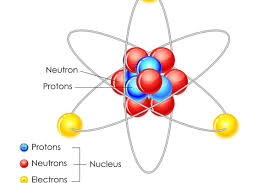
An atom is extremely small and cannot be seen with the naked eye. It consists of three main subatomic particles: protons, neutrons, and electrons. Protons carry a positive charge, neutrons have no charge, and electrons carry a negative charge. Protons and neutrons are located in the nucleus, which is the central part of the atom, while electrons move around the nucleus in different energy levels or shells.
One of the most important properties of an atom is its atomic number. The atomic number is equal to the number of protons present in the nucleus. It determines the identity of an element. For example, hydrogen has one proton, while oxygen has eight protons. Another important property is the atomic mass, which is the total number of protons and neutrons in the nucleus.
Atoms also differ in size. Generally, atomic size increases as we move down a group in the periodic table because additional electron shells are added. The arrangement of electrons in an atom greatly influences its chemical behavior. Atoms tend to gain, lose, or share electrons to achieve a stable electronic configuration. This leads to the formation of chemical bonds and compounds.
Another important property is electrical charge. Under normal conditions, atoms are electrically neutral because the number of protons equals the number of electrons. However, atoms can gain or lose electrons and become charged particles known as ions. Positively charged ions are called cations, while negatively charged ions are called anions.
Atoms possess chemical properties that determine how they react with other substances. Some atoms are highly reactive, such as sodium, while others are relatively unreactive, such as noble gases. The reactivity of an atom depends mainly on the number of electrons in its outermost shell.
Atoms also exhibit physical properties such as mass, volume, and density. These properties contribute to the characteristics of different elements and materials. Modern science has shown that atoms can release large amounts of energy through nuclear reactions, which are used in nuclear power plants and other applications.
The study of atoms has led to many scientific and technological advancements. Understanding atomic structure helps scientists develop new materials, medicines, and technologies that improve human life.
In conclusion, atoms are the fundamental units of matter and possess various physical and chemical properties. Their structure, composition, and behavior determine the nature of all substances in the universe. The study of atoms remains one of the most important fields of science, helping us understand the world at its most basic level.
