Introduction
One of the greatest questions in science is, “How did the universe begin?” The most widely accepted scientific explanation is the Big Bang Theory. Rather than describing an explosion in space, the theory explains that the universe itself began in an extremely hot, dense state and has been expanding ever since. Over billions of years, this expansion led to the formation of galaxies, stars, planets, and ultimately life on Earth.
What Is the Big Bang Theory?
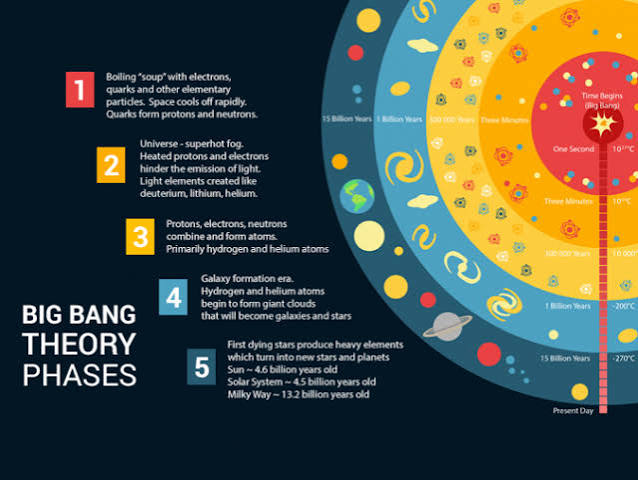
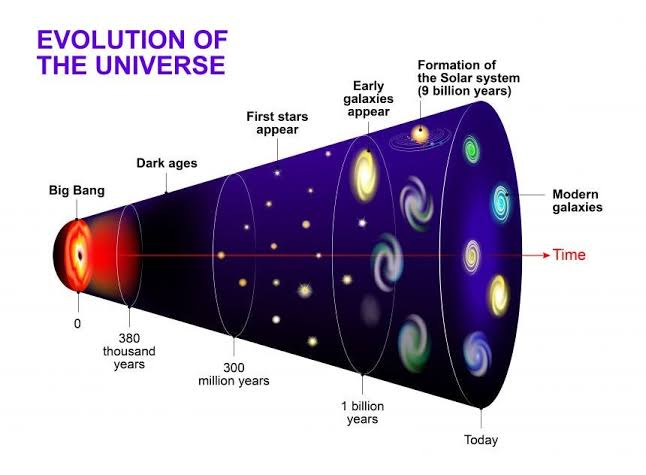
The Big Bang Theory states that the universe originated approximately 13.8 billion years ago from an incredibly hot and dense state. Space, time, matter, and energy began expanding together, creating the universe we observe today.
As the universe expanded, it cooled. This cooling allowed tiny particles to combine into atoms, which later formed stars, galaxies, and other cosmic structures through the force of gravity.
The Early Universe
Scientists believe that in the first moments after the Big Bang:
- The universe expanded extremely rapidly.
- Fundamental particles such as quarks and electrons formed.
- Protons and neutrons combined to create the nuclei of hydrogen and helium.
- Hundreds of thousands of years later, electrons joined these nuclei to form the first atoms.
- Gravity gradually pulled matter together, creating stars and galaxies.
These early events laid the foundation for everything that exists today.
Evidence Supporting the Big Bang Theory
The Expanding Universe
Astronomers discovered that distant galaxies are moving away from one another. This observation shows that the universe is expanding, suggesting it was once much smaller and denser.
Cosmic Microwave Background Radiation
A faint glow of microwave radiation fills the entire universe. This ancient light is considered one of the strongest pieces of evidence for the Big Bang because it is the leftover heat from the universe’s early stages.
Abundance of Light Elements
The observed amounts of hydrogen and helium throughout the universe closely match predictions made by the Big Bang Theory, providing additional support for the model.
How Stars and Galaxies Formed
After millions of years, gravity caused clouds of gas to collapse into stars. Groups of billions of stars formed galaxies, while leftover material around young stars eventually combined to create planets, moons, asteroids, and comets.
Our Solar System formed about 4.6 billion years ago, long after the universe itself began.
Questions Scientists Continue to Explore
Although the Big Bang Theory explains much about the universe’s evolution, several mysteries remain:
- What happened before the Big Bang?
- What are dark matter and dark energy?
- Why is the universe expanding at an accelerating rate?
- Are there other universes beyond our own?
Researchers continue using powerful telescopes, satellites, and advanced computer models to investigate these questions.
Why Understanding the Universe Matters
Studying the origin of the universe helps humanity understand its place in the cosmos. It advances physics, astronomy, and mathematics while driving technological innovations that benefit everyday life. Research into the universe also inspires curiosity, creativity, and international scientific collaboration.
The Future of Cosmology
Modern observatories and space telescopes are providing increasingly detailed views of distant galaxies and the early universe. Future missions may reveal new information about dark matter, dark energy, black holes, and the universe’s earliest moments, leading to even deeper understanding.
Conclusion
The Big Bang Theory remains the leading scientific explanation for the origin and evolution of the universe. Supported by decades of observations and research, it describes how a tiny, extremely hot, dense beginning evolved into the vast cosmos we see today. Although many mysteries remain, ongoing discoveries continue to expand our knowledge of the universe and inspire humanity’s quest to understand the origins of existence.