Introduction
Space has become one of the busiest frontiers of human activity. Thousands of satellites currently orbit Earth, providing services such as communication, navigation, weather forecasting, scientific research, and global internet connectivity. With governments, private companies, and research organizations launching more satellites every year, Earth’s orbit is becoming increasingly crowded.
Managing this growing number of spacecraft has created a new challenge known as Space Traffic Management (STM). Similar to how air traffic controllers guide airplanes safely through the skies, Space Traffic Management aims to monitor, coordinate, and regulate satellite movements to prevent collisions and ensure the long-term sustainability of space activities.
As humanity enters a new era of commercial space exploration, effective space traffic management will be essential for protecting satellites, astronauts, and future missions.
What Is Space Traffic Management?
Space Traffic Management refers to the systems, technologies, policies, and international cooperation used to monitor and coordinate the movement of satellites and other objects in Earth’s orbit.
The primary goals of STM include:
- Preventing collisions between satellites.
- Tracking space debris.
- Coordinating satellite launches.
- Managing orbital congestion.
- Protecting astronauts and space stations.
- Ensuring sustainable use of Earth’s orbital environment.
Unlike roads or airways, space has no universally accepted traffic control system. Developing one has become a priority as orbital activity continues to expand.
Why Space Traffic Management Is Becoming More Important
Over the past decade, the number of operational satellites has increased dramatically. Large satellite constellations for global broadband, Earth observation, and navigation are placing thousands of additional spacecraft into low Earth orbit.
This rapid growth creates several challenges:
Orbital Congestion
Certain orbital regions are becoming increasingly crowded, raising the risk of accidental collisions.
Space Debris
Millions of pieces of orbital debris travel at speeds exceeding 28,000 kilometers per hour. Even tiny fragments can severely damage satellites.
Increased Launch Activity
Reusable rockets have lowered launch costs, making space more accessible than ever before. As launch frequency increases, careful coordination becomes increasingly important.
How Space Objects Are Tracked
Space agencies use powerful radar systems, optical telescopes, and advanced computer models to monitor satellites and debris.
Tracking systems continuously calculate:
- Satellite positions
- Orbital speeds
- Predicted trajectories
- Potential close approaches
- Collision probabilities
Whenever two objects appear likely to pass dangerously close to one another, operators receive alerts and may perform collision-avoidance maneuvers.
The Role of Artificial Intelligence in Traffic Management
Artificial intelligence is becoming a valuable tool for managing the growing complexity of orbital traffic.
AI can:
- Predict collision risks more accurately.
- Analyze millions of orbital calculations in seconds.
- Recommend safer satellite maneuvers.
- Optimize orbital routes.
- Detect unusual satellite behavior.
- Automate monitoring of thousands of spacecraft simultaneously.
As satellite numbers continue to rise, AI-driven systems will become increasingly important for maintaining orbital safety.
International Cooperation
Space belongs to all humanity, making international cooperation essential for effective traffic management.
Countries and organizations are working together to:
- Share tracking data.
- Develop common safety standards.
- Coordinate satellite operations.
- Reduce orbital debris.
- Improve transparency among satellite operators.
Greater collaboration will help ensure that space remains accessible for peaceful scientific, commercial, and humanitarian activities.
Emerging Technologies
Future Space Traffic Management systems are expected to incorporate several advanced technologies.
These include:
- AI-powered monitoring systems
- Autonomous collision avoidance
- Laser communication networks
- High-precision navigation
- Digital orbital mapping
- Automated mission planning
These innovations will improve both safety and efficiency as orbital activity continues to expand.
Challenges Ahead
Several obstacles remain before a fully integrated global STM system becomes a reality.
These include:
- Lack of international regulations
- Increasing commercial competition
- Rapid satellite deployment
- Space debris accumulation
- Data-sharing limitations
- Cybersecurity concerns
Addressing these issues will require cooperation between governments, private companies, researchers, and international organizations.
The Future of Safe Space Operations
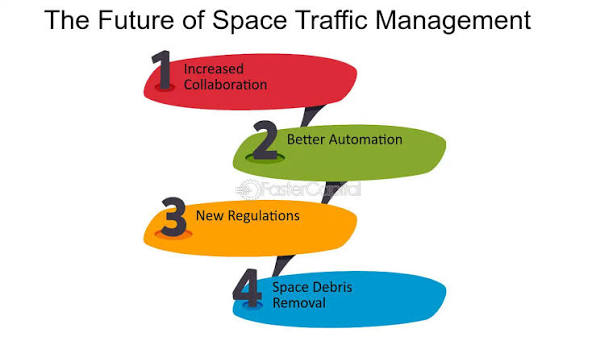
Future satellites may communicate directly with one another to coordinate orbital movements automatically. AI systems could continuously monitor Earth’s orbital environment and issue real-time instructions to prevent collisions before they occur.
As lunar missions, Mars exploration, and commercial space stations become more common, Space Traffic Management may eventually expand beyond Earth’s orbit to manage spacecraft throughout the Solar System.
Conclusion
Space Traffic Management is becoming one of the most important components of modern space exploration. As satellite launches continue to increase, protecting Earth’s orbital environment will require advanced technology, responsible operations, and strong international cooperation.
By combining artificial intelligence, global tracking networks, and improved regulations, humanity can ensure that space remains safe, sustainable, and accessible for future generations of explorers, scientists, and innovators.