Introduction
Business automation has become a key driver of growth and efficiency in today’s competitive marketplace. By using technology to perform repetitive tasks, organizations can reduce costs, improve accuracy, and allow employees to focus on high-value work. From small businesses to multinational corporations, automation is transforming operations across every industry. As Artificial Intelligence (AI), robotic process automation (RPA), and cloud-based software continue to evolve, businesses have more opportunities than ever to streamline their workflows.
What Is Business Automation?
Business automation involves using software, AI, and digital tools to complete routine tasks with minimal human intervention. Automated systems handle repetitive activities quickly and consistently, reducing errors while improving productivity.
Common automated processes include:
- Data entry
- Invoice processing
- Payroll management
- Customer support
- Email marketing
- Inventory tracking
- Appointment scheduling
- Financial reporting
Effective Business Automation Strategies
Identify Repetitive Tasks
The first step is to identify processes that consume significant time and resources. Automating repetitive tasks delivers immediate productivity improvements.
Implement AI-Powered Tools
AI can analyze customer behavior, automate responses, generate reports, forecast demand, and support business decision-making.
Use Robotic Process Automation (RPA)
RPA software automates rule-based tasks by interacting with digital systems just as humans do, making it ideal for finance, human resources, and administrative operations.
Integrate Business Systems
Connecting accounting, sales, customer relationship management (CRM), and inventory systems ensures smooth data flow across departments, eliminating duplicate work.
Automate Customer Service
AI-powered chatbots and virtual assistants provide instant support, answer common questions, and operate around the clock, improving customer satisfaction while reducing support costs.
Monitor and Optimize
Automation should be reviewed regularly to measure performance, identify bottlenecks, and improve workflows as business needs evolve.
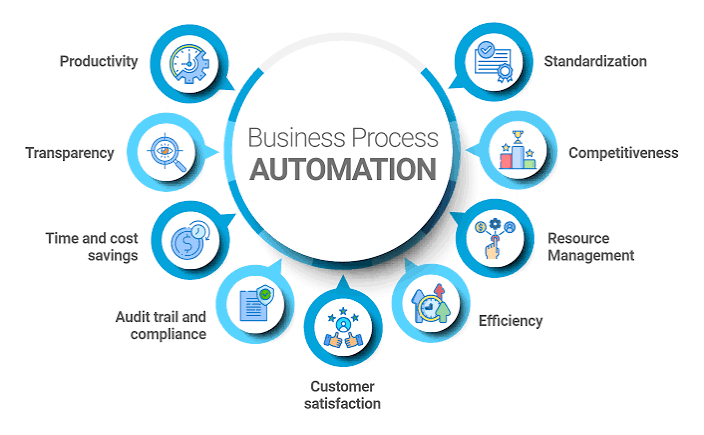
Benefits of Business Automation
Organizations that implement automation experience numerous advantages:
- Higher productivity
- Lower operational costs
- Improved accuracy
- Faster service delivery
- Better customer experiences
- Increased employee satisfaction
- Stronger compliance
- Scalable business operations
These benefits allow companies to respond more effectively to market changes and customer demands.
Challenges
Despite its advantages, automation also presents challenges:
- Initial investment costs
- Employee training requirements
- Integration with legacy systems
- Cybersecurity concerns
- Managing organizational change
- Ensuring ethical use of AI
A well-planned automation strategy helps minimize these risks while maximizing long-term value.
The Future of Business Automation
Future automation will become increasingly intelligent through AI, predictive analytics, autonomous software agents, and machine learning. Businesses will rely on smart systems that not only automate tasks but also recommend decisions, identify opportunities, and anticipate customer needs. Human employees will continue to play a critical role by providing creativity, innovation, and strategic leadership.
Conclusion
Business automation is no longer optional—it is a strategic necessity for organizations seeking long-term growth and competitiveness. By automating routine tasks, integrating digital systems, and adopting AI-powered solutions, businesses can improve efficiency, reduce costs, and deliver superior customer experiences. Companies that invest in thoughtful automation today will be better prepared for the opportunities and challenges of tomorrow.
Keywords: Business Automation, AI, Robotic Process Automation, Digital Transformation, Workflow Automation, Business Efficiency
