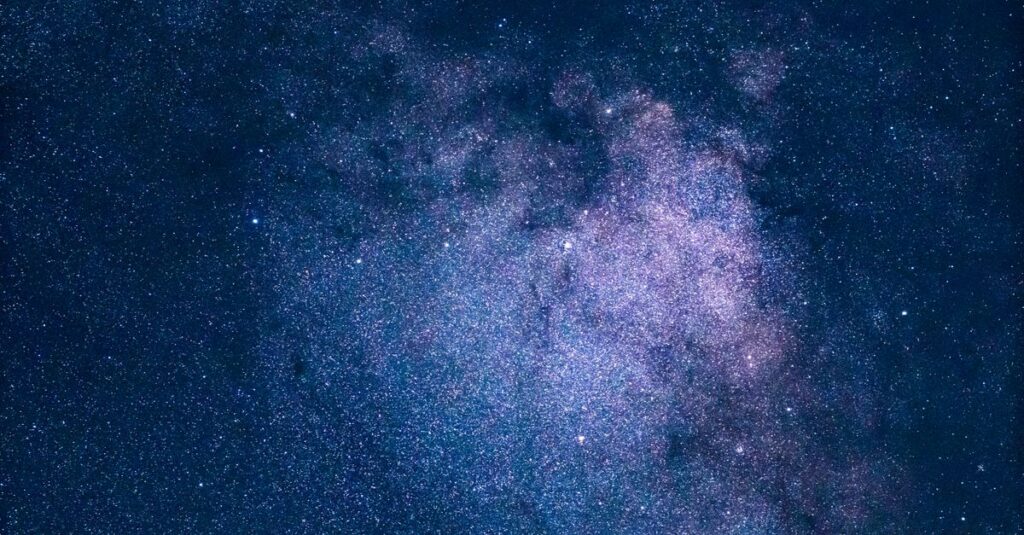
When the James Webb Space Telescope (JWST) began science operations in July 2022, it opened a window on the universe that no instrument had ever provided before. Stationed 1.5 million kilometres from Earth at a point called L2, Webb observes the cosmos in infrared light — the faint, stretched-out glow of the most distant galaxies and the warm radiation hidden behind clouds of cosmic dust. In just a few years, it has already rewritten parts of our astronomy textbooks.
Why Webb Sees What Others Cannot
The most powerful feature of the telescope is its gold-coated primary mirror, 6.5 metres across — nearly three times the diameter of Hubble’s. A larger mirror collects more light and sees finer detail, but Webb’s real superpower is infrared vision. As the universe expands, light from the earliest galaxies is stretched into infrared wavelengths before it reaches us. Hubble, which mostly sees visible and ultraviolet light, simply could not catch it.
Webb also carries four scientific instruments — NIRCam, NIRSpec, MIRI and FGS/NIRISS — that can image the sky and split starlight into spectra with unprecedented precision. Around 75 percent of Webb’s observations produce spectra, which reveal the temperature, motion, density and chemical makeup of objects billions of light-years away.
Peering at the First Galaxies
One of Webb’s headline achievements is the detection of some of the earliest galaxies ever observed. In 2026, NASA announced Webb had found MoM-z14, a galaxy that existed just 280 million years after the Big Bang — meaning its light travelled for more than 13.5 billion years to reach us. Such findings are forcing astronomers to rethink how quickly the first stars and galaxies assembled after the universe’s birth.
Webb has also revealed mysterious “little red dots” — compact, extremely distant objects first spotted in 2022 that continue to puzzle researchers, with one proposed pathway linking them to the growth of lower-redshift spiral galaxies.
Reading the Air of Alien Worlds
For students dreaming of life beyond Earth, Webb’s exoplanet work is the most exciting chapter. When an exoplanet passes in front of its star, a fraction of the starlight filters through the planet’s atmosphere. By analysing that light, Webb has measured the atmospheric chemistry of distant worlds — detecting water, methane, carbon dioxide and cloud cover on planets we will never visit.
The most debated case is K2-18 b, a planet about 2.6 times Earth’s size orbiting in the habitable zone of a red dwarf star 124 light-years away. Webb confirmed methane and carbon dioxide in its atmosphere, and one research team reported tentative signs of molecules linked to biological activity on Earth. Other teams, reanalysing the same data, found the evidence inconclusive — a perfect real-world lesson in how science argues with itself before declaring a discovery.
Stars Being Born, Up Close
Closer to home, Webb has produced breathtaking portraits of stellar nurseries. Its 2026 panorama of the star-forming region IC 348, just 1,000 light-years away, is one of the largest images it has ever released, showing newborn stars still wrapped in the gas that made them. In July 2026, Webb even directly discovered a giant planet, Beta Pictoris d, hiding in a famous young star system — proving the telescope can image worlds tens of light-years away, not just infer them.
What This Means for Students
Webb is more than a science story; it is a career signal. Astronomy today runs on data analysis, coding, statistics and machine learning — skills that students in almost any science degree can build. Much of Webb’s data is public, and students can explore it through NASA’s open archives and citizen-science projects. The telescope also reminds us that knowledge is provisional: even its most dramatic headlines are tested, challenged and refined — and that is exactly how science is supposed to work.
References
- NASA Science — James Webb Space Telescope
- NASA Science — What Webb Learns from Light
- NASA Science — Webb Science Overview
- NASA — Webb Telescope’s First Images of Unseen Universe
#JamesWebb #Space #Astronomy #NASA #Science
