The AI Horizon
Artificial Intelligence is no longer a concept confined to science fiction; it is the defining technology of the 21st century. The scope of AI is not a single linear path but a massive, expanding ecosystem that is fundamentally restructuring how we work, communicate, heal, and learn. From small-scale efficiency gains to solving grand global challenges, AI’s reach is pervasive and accelerating. This article explores the core sectors and concepts defining the vast scope of modern AI.
Mapping the AI Ecosystem: A Visual Guide
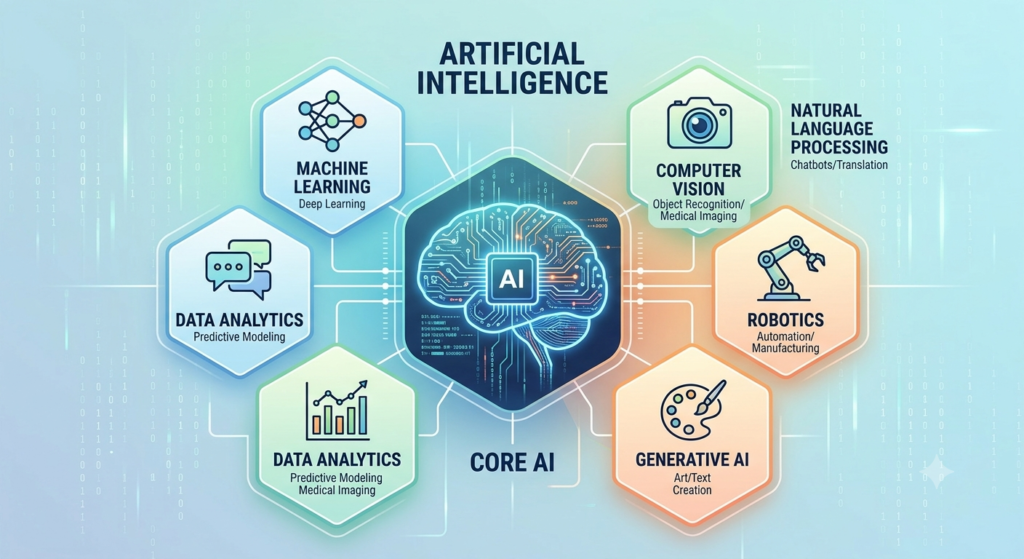
Understanding the breadth of AI requires visualizing its interconnected domains. The diagram below illustrates how foundational AI technologies (Machine Learning, Deep Learning, NLP) branch out into specialized applications that redefine various aspects of society, from creativity to healthcare.
Image Description: This schematic diagram, “The Scope of Artificial Intelligence,” centralizes ‘CORE AI’ and branches into key distinct modules: Machine Learning (Neural Nets, Deep Learning), Natural Language Processing (Chatbots, Translation), Computer Vision (Object Recognition, Medical Imaging), Robotics (Automation), Generative AI (Art/Text Creation), and Data Analytics (Predictive Modeling). Each hexagon features clear iconography
Foundational Pillars: The Engine of AI
The scope of AI is built upon several critical subfields, visualized in the core modules of Image 1.
1. Machine Learning (ML) and Deep Learning
As shown in the top-left hexagonal module (Image 1), Machine Learning is the fundamental engine. It allows systems to learn from data and improve over time without explicit programming. Within ML, Deep Learning—which utilizes multi-layered artificial neural networks—is responsible for the recent breakthroughs in complex pattern recognition, enabling almost all modern AI applications.
2. Natural Language Processing (NLP)
Visualized by the speech bubbles (Image 1), NLP gives machines the ability to understand, interpret, and generate human language. Its scope is immense, powering everything from real-time translation services and virtual assistants (like Siri or Alexa) to sophisticated sentiment analysis for market research.
3. Computer Vision (CV)
Represented by the camera eye and digital iris (Image 1), Computer Vision enables AI to “see” and interpret visual data. Its application scope is rapidly expanding, critical for:
Medical Imaging: Identifying anomalies in X-rays or MRIs with superhuman speed
- Autonomous Vehicles: Allowing cars to navigate by recognizing obstacles, lane markings, and signs.
- Security: Powering facial recognition and anomaly detection in surveillance.
Specialized Frontiers: Where AI Transforms Industries
Beyond foundational technologies, the applied scope of AI is restructuring specific sectors.
The Robotics & Automation Revolution
The ‘ROBOTICS’ module in the infographic, depicted as a precise robotic arm (Image 1), highlights the scope of AI in the physical world. While traditional robotics followed fixed scripts, AI-driven robotics can adapt to unstructured environments. In manufacturing (Industry 4.0), smart robots optimize assembly lines, predict maintenance needs, and manage logistics autonomously, moving from simple repetition to intelligent collaboration.
Generative AI: The New Creative Partner
The explosion of Generative AI (represented by the paint palette and pen, Image 1) has dramatically widened AI’s creative scope. These models, trained on vast datasets, can generate novel text, images, code, and even music. This isn’t just about automation; it’s a paradigm shift in human-AI collaboration, where AI acts as a co-pilot for designers, writers, and software engineers, accelerating the creative process and lowering entry barriers.
Conclusion: The Future Horizon
The scope of AI is not static; it is an expanding frontier. As visualized in the holistic diagram, AI is moving from isolated tasks toward an integrated intelligence ecosystem. The successful expansion of this scope depends on addressing critical ethical considerations, ensuring data privacy, and managing the societal impact on labor. The future scope of AI promises not just smarter machines, but a more insightful and capable human civilization, provided we navigate its development responsibly.
