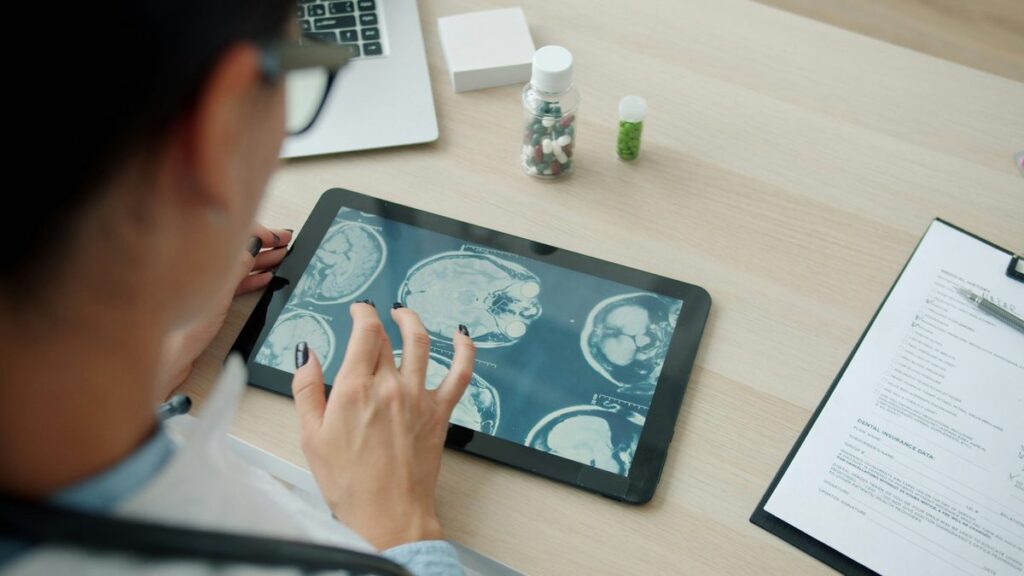
Artificial intelligence is no longer a futuristic promise in medicine — it is already at work in hospitals, clinics, and research laboratories around the world. Machine learning systems can now spot diseases in medical scans, predict which patients are most at risk, and help doctors make faster, more accurate decisions. For students thinking about careers in technology or medicine, understanding this transformation is no longer optional; it is essential.
How Machine Learning Learns Medicine
Training on millions of scans
Machine learning models learn by studying enormous datasets — millions of X-rays, MRIs, retinal photographs, and pathology slides that human experts have carefully labeled. By detecting patterns far too subtle for the human eye, these systems can flag the earliest warning signs of disease, sometimes long before symptoms appear. The larger and more diverse the dataset, the more reliable the model becomes.
From data to diagnosis
Once trained, a model can analyze a new scan in seconds and highlight suspicious regions for a radiologist to review. The physician still makes the final decision. The AI simply acts as a tireless second pair of eyes that never gets fatigued at the end of a long shift, reducing the chance that something important is overlooked.
Where AI Is Saving Lives Today
Earlier cancer detection
AI tools have demonstrated remarkable skill at finding breast cancer in mammograms, melanoma in dermoscopy images, and lung nodules in CT scans. Catching these cancers at earlier, more treatable stages directly translates into lives saved, and several health systems have already integrated such tools into routine screening programs.
Predicting patient risk
Hospitals now use machine learning to predict which patients are likely to develop sepsis, deteriorate overnight, or be readmitted after discharge. These early warnings give medical teams precious hours to intervene before a crisis unfolds, turning reactive care into preventive care.
Faster drug discovery
Developing a new drug traditionally takes a decade and enormous investment. Machine learning accelerates the process by predicting how candidate molecules will behave, allowing researchers to test the most promising options first and discard dead ends sooner. During recent global health emergencies, AI-assisted screening helped identify candidate compounds in weeks rather than years.
Personalized treatment
By analyzing a patient’s genetic profile alongside clinical data, AI helps oncologists choose therapies tailored to the individual rather than the average patient. This foundation of precision medicine means fewer side effects and better outcomes, because treatment matches the biology of the person receiving it.
Challenges Students Should Understand
Bias in training data
If a model learns mostly from data collected from one population, it may perform poorly for others. Building diverse, representative datasets is one of the field’s most urgent challenges, and an important lesson in responsible AI: powerful tools must work fairly for everyone.
Privacy and trust
Medical records are among the most sensitive data that exist. Techniques such as federated learning allow models to be trained across many hospitals without raw patient data ever leaving each institution, protecting privacy while still improving care for all.
The human touch remains essential
No algorithm can comfort a worried patient or navigate the ethical complexity of difficult treatment decisions. The most successful deployments of medical AI keep clinicians firmly in charge, using technology to extend human judgment rather than replace it.
What This Means for Your Future
Whether you aim to become a doctor, a data scientist, or a policymaker, the intersection of AI and healthcare will shape your career. Students can start today: learn basic statistics and programming, follow reputable medical AI research, and think critically about how technology should serve patients. The next breakthrough may come from someone sitting in a classroom right now.
Conclusion
Machine learning is not replacing doctors — it is amplifying what they can do. By catching disease earlier, predicting risk sooner, and personalizing treatment, AI is already saving lives every day. The students who understand both the technology and its human impact will define the next era of medicine.
References
World Health Organization — Ethics and governance of artificial intelligence for health: https://www.who.int/publications/i/item/9789240029200
Wikipedia — Artificial intelligence in healthcare: https://en.wikipedia.org/wiki/Artificial_intelligence_in_healthcare
#AI #Healthcare #MachineLearning #Innovation #FutureTech
