Introduction
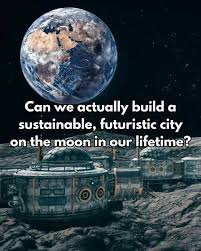
The idea of building cities on the Moon has fascinated scientists, writers, and dreamers for generations. Today, advances in space technology are turning this vision into a serious scientific goal. Although constructing permanent lunar settlements presents enormous challenges, ongoing research suggests that humans may one day establish thriving communities on Earth’s closest celestial neighbor.
Why Build on the Moon?
The Moon offers several advantages for future exploration. Its proximity to Earth allows missions to travel there in just a few days, making it an ideal location for testing technologies needed for deeper space missions.
A permanent lunar settlement could serve as a research center, a launch base for Mars missions, and a platform for scientific discoveries.
Building Lunar Habitats
Future Moon cities would require strong, radiation-resistant structures. Scientists are exploring ways to use lunar soil, known as regolith, to construct buildings using advanced 3D-printing technology.
Using local materials would reduce the need to transport construction supplies from Earth, making lunar settlements more practical and cost-effective.
Energy and Resources
Reliable energy will be essential for life on the Moon. Solar panels placed in regions with nearly continuous sunlight could provide electricity, while compact nuclear reactors may offer backup power.
Water ice discovered in permanently shadowed lunar craters could supply drinking water, produce oxygen for breathing, and generate hydrogen fuel for spacecraft.
Living on the Moon
Future lunar cities would include living quarters, laboratories, greenhouses, medical facilities, and communication centers. Indoor farming techniques could provide fresh food, while advanced recycling systems would conserve water and air.
Artificial intelligence and robots would perform many dangerous tasks, helping maintain infrastructure and supporting astronauts.
Challenges to Overcome
Despite exciting progress, several obstacles remain. The Moon has no breathable atmosphere, experiences extreme temperature changes, and exposes residents to harmful radiation and micrometeorites.
Scientists must also understand the long-term effects of low gravity on human health before permanent settlements become possible.
Looking Ahead
Many space agencies and private companies are actively developing technologies that could support future lunar missions. Continued international collaboration will be essential for transforming temporary Moon bases into permanent communities.
Conclusion
Building cities on the Moon remains one of humanity’s greatest engineering challenges, but it is becoming increasingly realistic. As technology advances, lunar settlements could become the first step toward a future where humans live and work beyond Earth, opening a new era of exploration and discovery.
