Introduction
Artificial Intelligence (AI) is transforming the global workforce faster than any previous technological revolution. Businesses across industries are adopting AI to improve productivity, automate routine tasks, and make better decisions. While AI creates new opportunities, it also changes the skills employees need to remain competitive. Understanding how AI is reshaping work helps individuals prepare for the future of employment.
AI in the Workplace
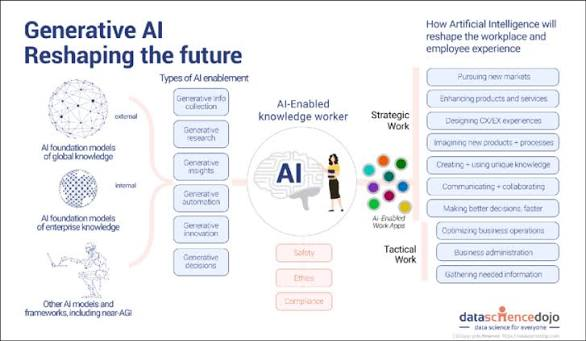
AI systems perform tasks such as analyzing data, recognizing speech, generating content, translating languages, detecting fraud, and assisting customer service teams. Rather than replacing all workers, AI often supports employees by handling repetitive work, allowing people to focus on creativity, strategy, and problem-solving.
Industries Being Transformed
Healthcare
AI assists doctors by analyzing medical images, supporting diagnosis, predicting disease risks, and accelerating drug discovery.
Education
AI-powered learning platforms personalize lessons based on each student’s strengths and weaknesses, making education more effective.
Manufacturing
Smart factories use AI to monitor equipment, improve quality control, predict maintenance needs, and optimize production processes.
Finance
Banks and financial institutions use AI to detect fraud, assess financial risks, automate customer support, and improve investment strategies.
Retail
Retailers analyze customer behavior, manage inventory efficiently, and provide personalized shopping recommendations using AI.
New Career Opportunities
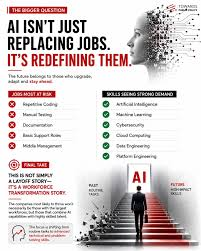
As AI adoption grows, demand is increasing for professionals in fields such as:
- AI Engineering
- Machine Learning
- Data Science
- Cybersecurity
- Robotics Engineering
- Cloud Computing
- AI Ethics and Governance
- Prompt Engineering
- Business Intelligence
- Digital Transformation Consulting
Skills for the AI Era
Future professionals should develop both technical and human-centered skills, including:
- Digital literacy
- Critical thinking
- Creativity
- Communication
- Problem-solving
- Programming
- Data analysis
- Adaptability
- Collaboration
- Continuous learning
Challenges
Despite its advantages, AI presents several challenges:
- Job displacement in repetitive roles.
- Privacy and data security concerns.
- Ethical issues surrounding AI decision-making.
- Bias in AI systems.
- The need for workforce reskilling and upskilling.
Governments, businesses, and educational institutions are working together to help workers transition into new technology-driven roles.
The Future of Work
The future workplace will likely involve close collaboration between humans and AI systems. Rather than replacing human intelligence, AI will augment it by improving productivity and enabling workers to solve more complex problems. Organizations that invest in employee training and responsible AI adoption will be better positioned for long-term success.
Conclusion
Artificial Intelligence is reshaping the global workforce by changing how businesses operate and how employees perform their jobs. While automation is transforming many industries, it is also creating exciting career opportunities for those willing to learn new skills. By embracing continuous education and digital innovation, workers can thrive in an AI-powered future.