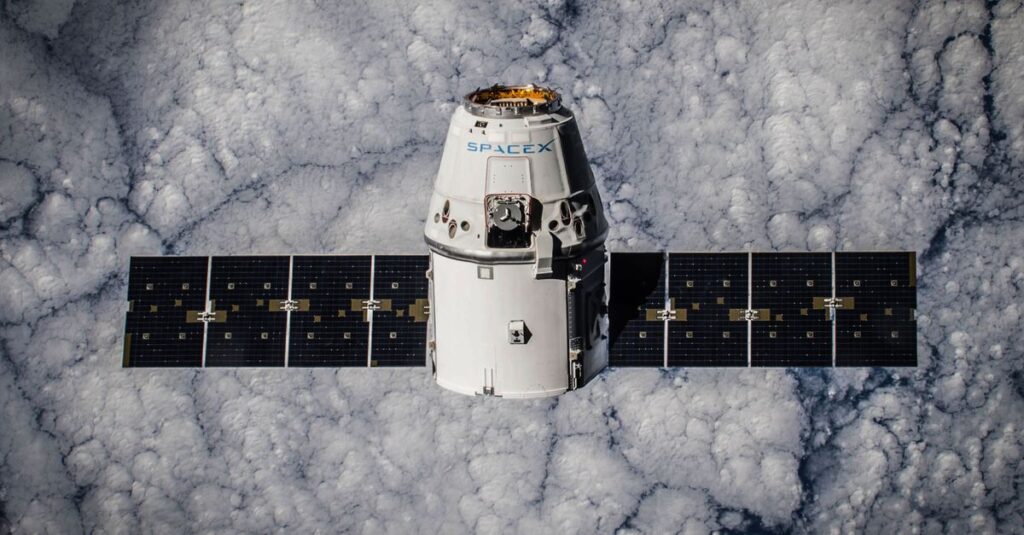
Every time your phone drops a blue dot on a map, a quiet conversation is happening between your device and a fleet of satellites racing overhead at nearly 14,000 kilometers per hour. The Global Positioning System — GPS — pinpoints your position anywhere on Earth to within a few meters, using nothing but radio signals and extremely precise timing. The physics behind it is surprisingly elegant, and it runs on an idea older than the system itself.
The Constellation Overhead
GPS is a network of at least 24 operational satellites (there are currently around 31) spread across six orbital planes, circling the planet at an altitude of about 20,200 kilometers. Each satellite completes two orbits per day. The arrangement is designed so that from almost any point on Earth, at least four satellites are visible at any given moment. Every one of them continuously broadcasts a simple message: where it is, and exactly what time it is.
Turning Time Into Distance
The core trick of GPS is converting time into distance. Radio signals travel at the speed of light — roughly 300,000 kilometers per second — which is constant and known. When your phone receives a satellite’s message, it compares the timestamp inside the message with the moment the signal arrived. That tiny delay, often less than a tenth of a second, tells the receiver exactly how far away the satellite is. One distance measurement places you somewhere on an enormous imaginary sphere centered on that satellite.
Trilateration: Pinning Down a Point
Finding your position from distances is a mathematical technique called trilateration (not to be confused with triangulation, which uses angles). It works in stages:
- One satellite: Your distance from it puts you somewhere on a giant sphere. Far too vague to be useful.
- Two satellites: The two spheres overlap in a ring. You are somewhere on that circle — better, but still not a point.
- Three satellites: A third sphere narrows the possibilities to just two points, and one is usually physically impossible — deep in space or underground — leaving your real position. This gives you latitude and longitude.
- Four satellites: The fourth measurement is not about geometry at all. It fixes your receiver’s clock.
Why the fourth satellite matters
GPS satellites carry atomic clocks that keep time to within a billionth of a second. Your phone does not — it has a cheap quartz clock that drifts. Because distance is calculated from signal travel time, even a one-microsecond clock error would misplace you by about 300 meters. The fourth satellite’s measurement lets the receiver solve for four unknowns at once: latitude, longitude, altitude, and its own clock error. That is how a budget smartphone can keep time with an atomic clock in orbit.
Einstein in Your Pocket
Here is the part that surprises most students: GPS would not work without relativity. Two effects of Einstein’s theories pull satellite clocks in opposite directions. Special relativity says the fast-moving satellites’ clocks tick slightly slower (about 7 microseconds per day behind), while general relativity says that in weaker gravity, high above Earth, they tick faster (about 45 microseconds per day ahead). The net result is roughly 38 microseconds per day — enough, if left uncorrected, to create navigation errors of about 11 kilometers per day. Engineers pre-adjust the satellite clocks to compensate, making GPS one of the few everyday technologies that genuinely requires Einstein’s equations to function.
What Can Go Wrong
GPS signals are remarkably faint by the time they reach the ground — weaker than background radio noise — and several things can corrupt them. The ionosphere slows signals down, tall buildings block or reflect them (the “urban canyon” effect that makes your dot jump between streets downtown), and bad satellite geometry spreads errors out. That is why your phone also leans on cell towers and Wi-Fi signals — Assisted GPS — to get a first fix quickly, especially indoors.
Beyond Directions
GPS is no longer just about navigation. Because it distributes ultra-precise time, it quietly synchronizes power grids, cellular networks, and financial transactions around the world. Rival systems now fly too — Russia’s GLONASS, Europe’s Galileo, China’s BeiDou — so modern phones are really listening to multiple constellations. The next time you follow turn-by-turn directions, remember: your blue dot is the product of atomic clocks, orbital mechanics, and a century-old theory of physics, all working together in the palm of your hand.
References
- Scienceline – How Does Your GPS Know Where You Are?: satellite broadcasts, trilateration and Assisted GPS explained
- When Notes Fly – How GPS Functions: Satellite Navigation Explained: trilateration, atomic clocks, relativity corrections and error sources
#GPS #Satellites #Science #Technology #Explained
