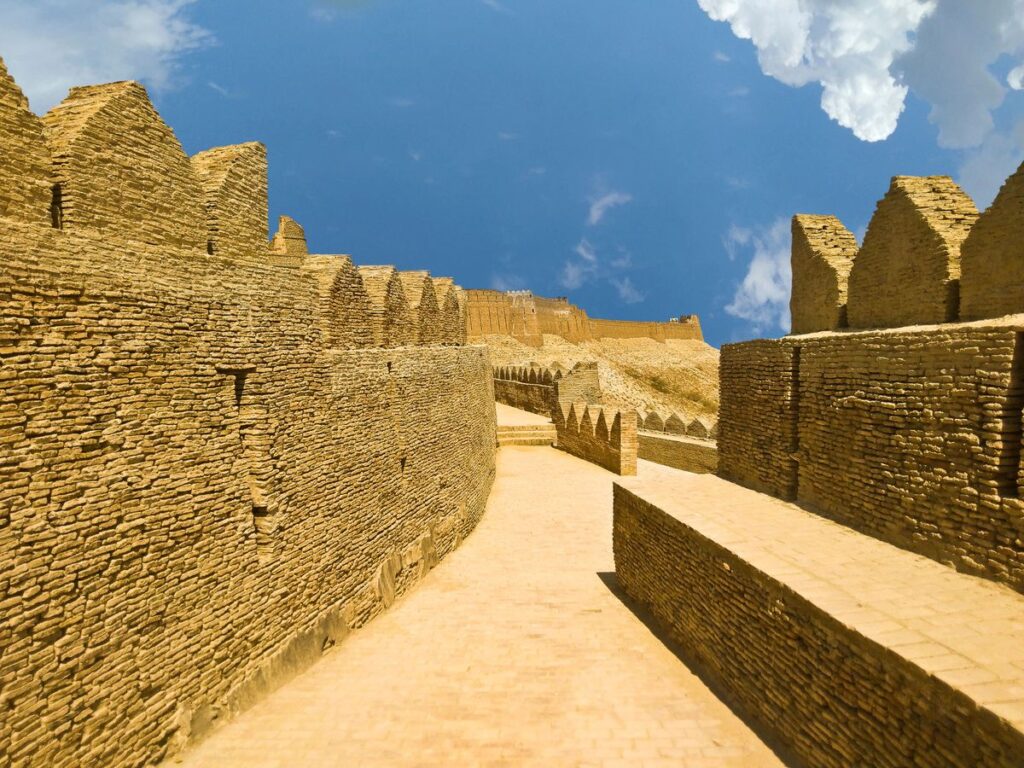
One of the World’s Oldest Cities — Right Here in Pakistan
Around 4,500 years ago, while ancient Egypt was raising its pyramids and Mesopotamia was writing its first cuneiform tablets, a third great civilization was rising along the Indus River. Its cities were larger, its streets straighter, and its plumbing better than anything in the ancient world — yet the entire civilization was forgotten until the 1920s, when excavations in what is now Pakistan revealed its two greatest cities: Harappa and Mohenjo-daro.
The name “Mohenjo-daro” means “Mound of the Dead” in Sindhi. It sits on elevated ground in Larkana district, Sindh, and it is one of the most important archaeological sites on Earth.
What Was the Indus Valley Civilization?
The Indus Valley (or Harappan) Civilization arose around 3300 BCE along the Indus River and its tributaries, reaching its peak between roughly 2600 and 1900 BCE. At its greatest extent, its geographical reach was larger than Egypt or Mesopotamia. More than a thousand settlements have been identified across what is now Pakistan and northwestern India, connected by standardized weights and measures, shared craft traditions, and an active trade network that reached Mesopotamia.
This was a civilization of cities — not of palaces and kings, as we’ll see — and for roughly 700 years its urban centers ran like clockwork.
Mohenjo-daro: The City of Mounds
Discovery
Archaeologists first visited the site in 1911, but the ruins were properly recognized in 1922 when R. D. Banerji of the Archaeological Survey of India began excavations there. Major digs followed through the 1920s and 1931, with later excavations in 1950 and 1964. In 1980, UNESCO designated Mohenjo-daro a World Heritage Site — Pakistan’s first.
Key Discoveries
The Great Bath. The city’s most famous structure is a watertight pool, roughly 12 meters long and 7 meters wide, built of baked brick sealed with bitumen on the tallest mound of the city. With no temple, palace, or monument found nearby, archaeologists believe it served ritual bathing — National Geographic explorer Jonathan Mark Kenoyer calls it evidence of an ideology built around cleanliness.
Grid streets and the world’s first sewers. Mohenjo-daro was laid out on a precise grid, with streets running north–south and east–west at right angles. Houses — often two storeys, built of standardized baked bricks — had bathrooms and toilets connected to a covered drainage network running alongside the streets. Wells were scattered throughout the city. Nothing like this existed anywhere else in the world for another 2,000 years.
The Dancing Girl and the Priest-King. Excavations uncovered a 10.5-centimeter bronze statuette of a young woman in a confident pose — the famous “Dancing Girl,” found in 1926 — alongside intricately carved stone figures like the so-called Priest-King (a name archaeologists now treat with caution, since there’s no evidence he was either). Along with ivory, lapis, carnelian, and gold beads, these finds show a culture with serious artistic skill.
Seals and an unreadable script. The Indus people used beautifully engraved steatite seals — stamped with animals and lines of pictographic script — for trade and administration. That script has never been deciphered. Nearly a century of attempts have failed, which means the Indus people left us no readable history: everything we know comes from their bricks, drains, and beads.
What We Still Don’t Know
Mohenjo-daro is sometimes called “faceless,” and that’s accurate. No king’s palace. No temple. No grand tomb. No evidence of a single ruler — the city was likely run as a city-state by elected officials or elites from different mounds. This flat hierarchy puzzles archaeologists: how did a society build such precise infrastructure without an obvious centralized power?
The decline is equally mysterious. Around 1900 BCE the cities began to fade. Kenoyer suggests the Indus River changed course, damaging agriculture and trade; others point to climate shifts or internal change. There is no evidence of a single catastrophic flood or invasion — the culture transformed rather than collapsed overnight.
Why It Matters Today
Mohenjo-daro is more than ancient history; it’s a living heritage site under threat. Erosion, salinity, and climate change are damaging the exposed brickwork, and UNESCO and the Pakistani government continue preservation efforts, including modern 3D mapping and drone surveys. The site appears in Pakistani school and university curricula, and students can visit the Mohenjo-daro museum near the ruins in Larkana district.
A city built 4,500 years ago on clean water, planned streets, and standardized craftsmanship — run, apparently, without kings — still has lessons to teach about what makes a civilization work. If you get the chance to stand among those bricks, take it.
References
- National Geographic, “The lost city of Mohenjo Daro” — https://www.nationalgeographic.com/history/article/mohenjo-daro
- FactMonster (Columbia Electronic Encyclopedia), “Indus valley civilization” — https://Www.Factmonster.com/encyclopedia/history/asia-africa/south-asia/indus-valley-civilization
- Knowledge.Deck.no, “Mohenjo-Daro and Harappa” — https://knowledge.deck.no/history/ancient-history/indus-valley-civilization/mohenjo-daro-and-harappa
#MohenjoDaro #IndusValley #History #Pakistan
