
Countries With the Highest Reported Rape Rates — and Where to Get Help
The table below shows the countries with the highest police-recorded rape rates per 100,000 people, based on UNODC crime data (latest available figures, 2020–2024). Read this carefully: these are reported cases only. Definitions of rape, police recording practices, and victims’ willingness to report differ hugely between countries — so a higher number often reflects a better reporting system (for example Sweden’s broad legal definition and strong support services), not necessarily more violence. Countries with very low reported rates often suffer the worst underreporting.
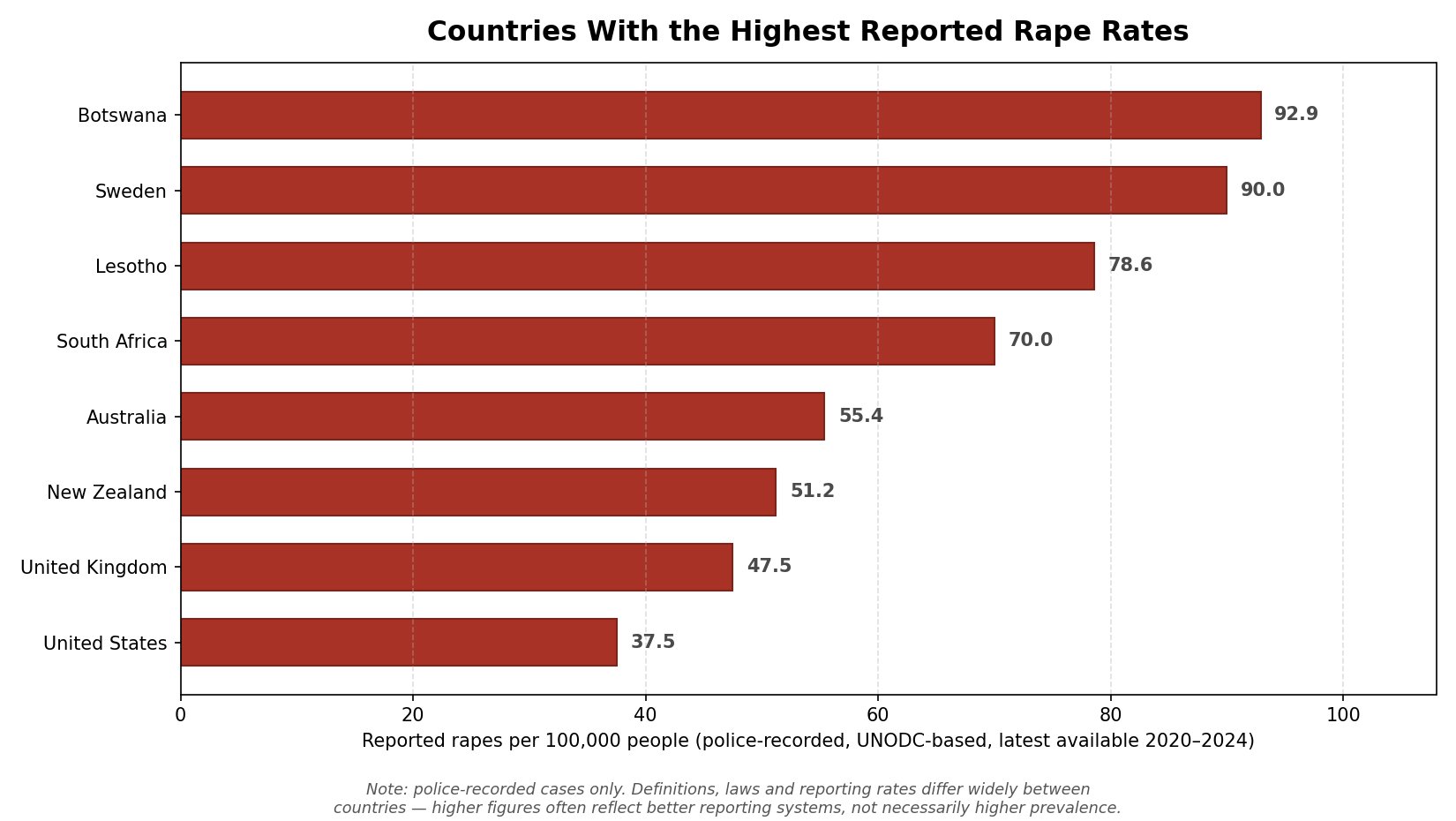
| Country | Reported rate (per 100,000) | Helpline (free & confidential) |
|---|---|---|
| Botswana | 92.9 | GBV Prevention & Support Centre: 14655 (toll-free) |
| Sweden | 90.0 | Kvinnofridslinjen: 116 016 (24/7) |
| Lesotho | 78.6 | Toll-free GBV helpline: 800 666 66 |
| South Africa | 70.0 | GBV Command Centre: 0800 428 428 (24/7) |
| Australia | 55.4 | 1800RESPECT: 1800 737 732 (24/7) |
| New Zealand | 51.2 | Safe to Talk: 0800 044 334 (24/7) |
| United Kingdom | 47.5 | Rape Crisis Support Line: 0808 500 2222 (24/7) |
| United States | 37.5 | RAINN: 1-800-656-4673 (24/7) |
If you or someone you know needs help in any of these countries, save the helpline number from the table. In an emergency, always call your local emergency number first.
What Is Rape and Sexual Assault?
Rape is any non-consensual sexual act forced on a person through threats, violence, manipulation, or when the person cannot give consent. Sexual assault is a broader term. It covers any unwanted sexual contact, from harassment to forced acts.
Rape awareness means understanding what sexual assault is, why it happens, how to prevent it, and how to stand with survivors. Too many cases go unreported because of fear, shame, or victim-blaming. Awareness breaks that silence.
Why Rape Awareness Matters
The World Health Organization reports that about 1 in 3 women worldwide have experienced physical or sexual violence in their lifetime. Most assaults are never reported to police. When communities talk openly about consent and assault, reporting goes up, myths fade, and survivors feel less alone.
Understanding Consent: The Core of It All
Consent is a clear, freely given, and enthusiastic agreement to sexual activity. It must be ongoing and can be withdrawn at any time. Silence is not consent. A previous relationship is not consent. Being drunk or unconscious means a person cannot consent. If it is not a clear yes, it is a no.
Common Myths vs Facts
Myth: What a person wears invites assault. Fact: Clothing never causes rape; blaming clothes shifts blame from the attacker to the victim.
Myth: Most rapists are strangers. Fact: Most attackers are known to the victim — acquaintances, relatives, colleagues, or partners.
Myth: False reports are common. Fact: False reporting rates are very low; the far bigger problem is underreporting.
Myth: Men cannot be victims. Fact: Men and boys are also assaulted, and stigma makes it even harder for them to speak up.
Prevention: What We Can All Do
Teach children about body safety, boundaries, and the right to say no from an early age. Schools need clear anti-harassment policies that are actually enforced. Practice bystander intervention: if you see someone being harassed, step in, distract, or get help. Challenge everyday attitudes that excuse assault.
Safety Tips Worth Knowing
Share your live location with a trusted person when going out. Avoid isolated areas late at night when possible. Keep your phone charged. Trust your instincts — if a situation feels wrong, leave. Remember the golden rule: an assault is always the attacker’s fault, never the victim’s.
How to Support a Survivor
Believe them. Thank them for trusting you. Listen without judging or interrupting. Do not ask “why” questions that sound like blame. Let them make their own decisions about reporting or medical help, and do not pressure them.
Where to Get Help
In Pakistan, the national toll-free helpline 1099 (Ministry of Human Rights) operates 24/7 for reporting violence against women and getting legal advice and referrals. In Punjab, the women’s toll-free helpline 1043 offers counseling and complaint registration day and night. You can also approach the police, a hospital medico-legal unit, or trusted local NGOs.
Conclusion
Rape awareness is about replacing silence with knowledge and judgment with compassion. Learn what consent means. Reject the myths. Intervene when you can. Support survivors without conditions. Change starts with informed people refusing to look away.
References
- World Health Organization — Violence against women prevalence estimates
- UN Women — Facts and figures on ending violence against women
- Ministry of Human Rights, Pakistan — National helpline 1099
- Punjab Commission on the Status of Women — Helpline 1043
#RapeAwareness #EndSexualViolence #ConsentMatters #SupportSurvivors #BreakTheSilence #WomensSafety #AwarenessMatters
