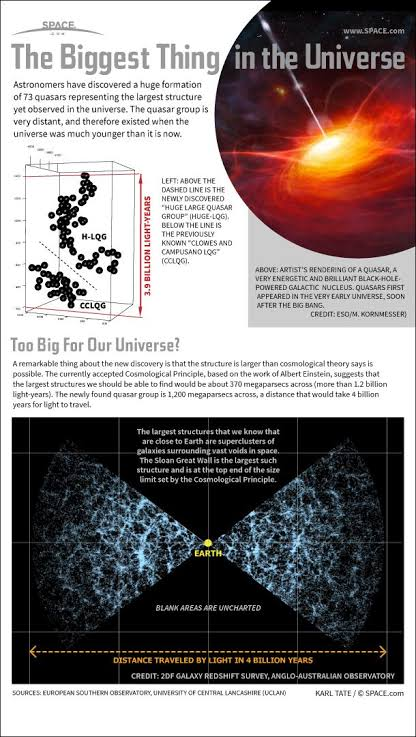
The universe is so vast that even the largest galaxies are only tiny pieces of an enormous cosmic web. Over billions of years, gravity has shaped matter into gigantic structures stretching across hundreds of millions of light-years. These colossal formations challenge our understanding of how the universe evolved and continue to fascinate astronomers around the world.
Understanding Cosmic Structure
The universe is not randomly organized. Galaxies gather into clusters, which join together to form superclusters. These superclusters are connected by long strands of galaxies known as cosmic filaments, separated by enormous empty regions called cosmic voids. Together, they create a vast network known as the cosmic web.
Galaxy Clusters
Galaxy clusters are among the largest gravitationally bound structures in the universe. Each cluster contains hundreds or even thousands of galaxies, along with hot gas and invisible dark matter. These clusters help astronomers understand how gravity shapes the cosmos over billions of years.
Superclusters
Even larger than galaxy clusters are superclusters—massive collections of galaxy clusters extending across hundreds of millions of light-years. Although gravity influences their formation, many superclusters are so enormous that the expansion of the universe prevents them from remaining permanently bound together.
The Great Wall Structures
Astronomers have discovered immense “walls” of galaxies stretching across the universe. These structures are among the largest known formations ever observed, containing thousands of galaxies arranged in long interconnected chains.
One of the most remarkable discoveries is the Hercules–Corona Borealis Great Wall, a structure so vast that it spans billions of light-years. Although scientists continue to debate its exact size and nature, it demonstrates just how enormous the universe truly is.
Cosmic Voids
Not all giant structures contain galaxies. Cosmic voids are enormous regions where very few galaxies exist. Some stretch across hundreds of millions of light-years, creating vast empty spaces between galaxy-rich regions.
Studying these voids helps astronomers understand how matter is distributed throughout the universe.
The Role of Dark Matter
Much of the universe’s large-scale structure is shaped by dark matter. Although invisible, dark matter’s gravitational influence guides the formation of galaxies and clusters, acting like an invisible framework upon which ordinary matter gathers.
Without dark matter, the universe would likely look very different.
How Scientists Discover These Structures
Modern observatories map millions of galaxies using powerful telescopes and advanced computer models. By measuring galaxy positions and distances, astronomers create three-dimensional maps of the universe that reveal its gigantic architecture.
Artificial intelligence now helps analyze these enormous datasets, making it easier to detect previously unknown structures.
Why These Discoveries Matter
Studying the universe’s largest structures helps answer fundamental questions:
- How did the universe evolve?
- How does gravity shape cosmic matter?
- What role does dark matter play?
- How will the universe change in the distant future?
Each new discovery improves our understanding of the cosmos and the physical laws governing it.
Conclusion
The largest structures ever discovered remind us that the universe is far more vast and complex than we once imagined. From galaxy clusters and superclusters to immense cosmic walls and giant voids, these breathtaking formations reveal the incredible scale of creation. As new telescopes continue exploring the cosmos, even larger structures may yet be discovered.
