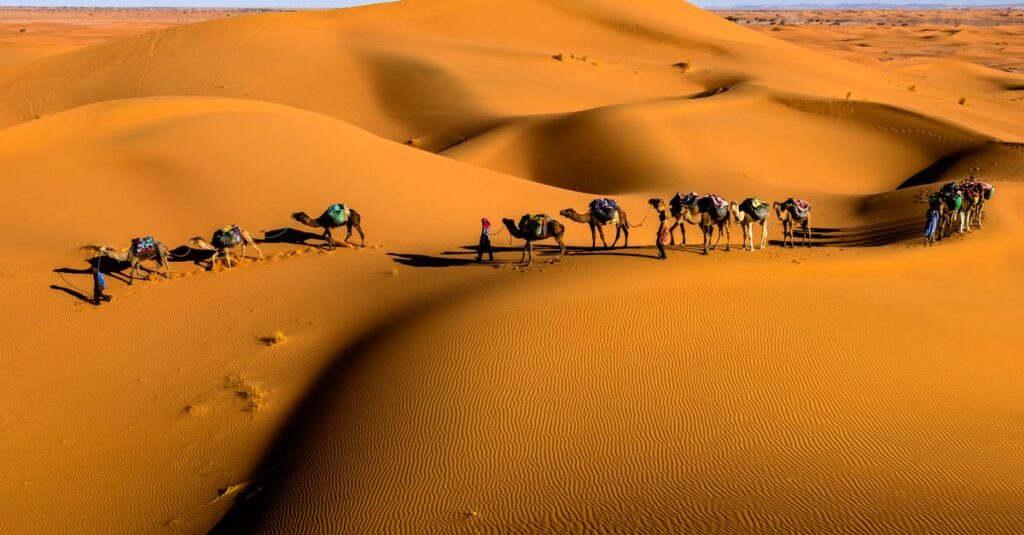
Long before airplanes and fiber-optic cables, camel caravans carried the world’s most precious cargo across deserts and mountain passes — not just silk and spices, but religions, alphabets, medicines, and ideas. The Silk Road was never a single highway; it was a vast web of land and sea routes stretching some 6,400 kilometers from China to the Mediterranean, active from around the second century BCE until the mid-15th century. Understanding it is understanding how our connected world began.
Where the Road Ran
The classic overland route began at Chang’an (modern Xi’an) in north-central China, followed the Great Wall westward, skirted the deadly Taklamakan Desert, climbed the Pamir Mountains, crossed what is now Afghanistan, and continued to the Levant — from where goods were shipped across the Mediterranean to Europe. There were also major branches south into India and north across the steppe, plus a maritime “spice route” linking East and West by sea through ports like Guangzhou and Quanzhou.
The Han dynasty expansion into Central Asia around 114 BCE, driven by the missions of the envoy Zhang Qian, brought the region under unified control and made organized long-distance trade possible. The Parthian Empire then served as a vital bridge connecting the network to the Mediterranean, and the rise of Rome anchored the western end of the system.
What Traveled East and West
Silk gave the road its name — by the first century CE, Chinese silk was widely sought after in Rome, Egypt, and Greece — but the cargo list was far richer. From the East came tea, porcelain, paper, gunpowder, dyes, perfumes, and spices. From the West came horses, camels, wool, gold, silver, glassware, and wine. In practice, most merchants traveled only short segments; goods changed hands at oasis cities like Samarkand, Kashgar, and Dunhuang, each leg adding a markup.
Ideas, not just goods
UNESCO describes the Silk Roads as one of history’s greatest engines of cultural exchange. Buddhism traveled from India into China and Central Asia along these routes. Nestorian Christianity, Islam, Zoroastrianism, and Manichaeism spread across Eurasia the same way. Artistic styles, scientific knowledge, paper-making technology, and even agricultural crops crossed borders centuries before globalization had a name.
The darker cargo
Disease traveled the routes too. Many scholars believe the bubonic plague moved along these trade corridors from Asia to Europe, helping cause the Black Death pandemic of the mid-14th century — a reminder that connectivity has always carried risk along with reward.
The People of the Road
The Silk Road was built by countless ordinary people, not a few famous names: Chinese and Persian merchants, Sogdian middlemen (dominant from the 5th to 8th centuries), Arab traders, Greek and Armenian brokers, Indian monks, and later Mongol administrators. Marco Polo is the most famous European traveler associated with the routes, but the roads existed for more than a thousand years before his 13th-century journey.
Oasis cities thrived as cultural melting pots. Dunhuang’s Mogao Caves, with their 492 painted temples, preserve Buddhist art shaped by Indian, Persian, and Chinese influences side by side — physical proof that trade and culture moved together.
Why It Still Matters Today
The Silk Road declined with the rise of sea-based European trade in the 1400s, but its legacy never disappeared:
- UNESCO recognition: In 2014, the 5,000-km Chang’an–Tianshan corridor across China, Kazakhstan, and Kyrgyzstan was inscribed as a World Heritage Site, with 33 component sites.
- Modern echoes: The routes inspired modern infrastructure visions — from trans-Asian highways to China’s Belt and Road Initiative.
- Cultural DNA: Foods, musical instruments, religious traditions, and words in dozens of languages trace back to Silk Road exchanges.
- A lesson for students: The road proves that civilization advances fastest when societies exchange knowledge openly — the original study-abroad program, centuries before universities existed.
For today’s students dreaming of studying abroad, the Silk Road is worth remembering: the urge to cross borders in search of knowledge is one of humanity’s oldest instincts, and it built the world we live in.
References
- UNESCO – About the Silk Roads
- Encyclopaedia Britannica – Silk Road: Facts, History & Map
- Wikipedia – Silk Road
#SilkRoad #History #TradeRoutes #Culture #Civilizations
