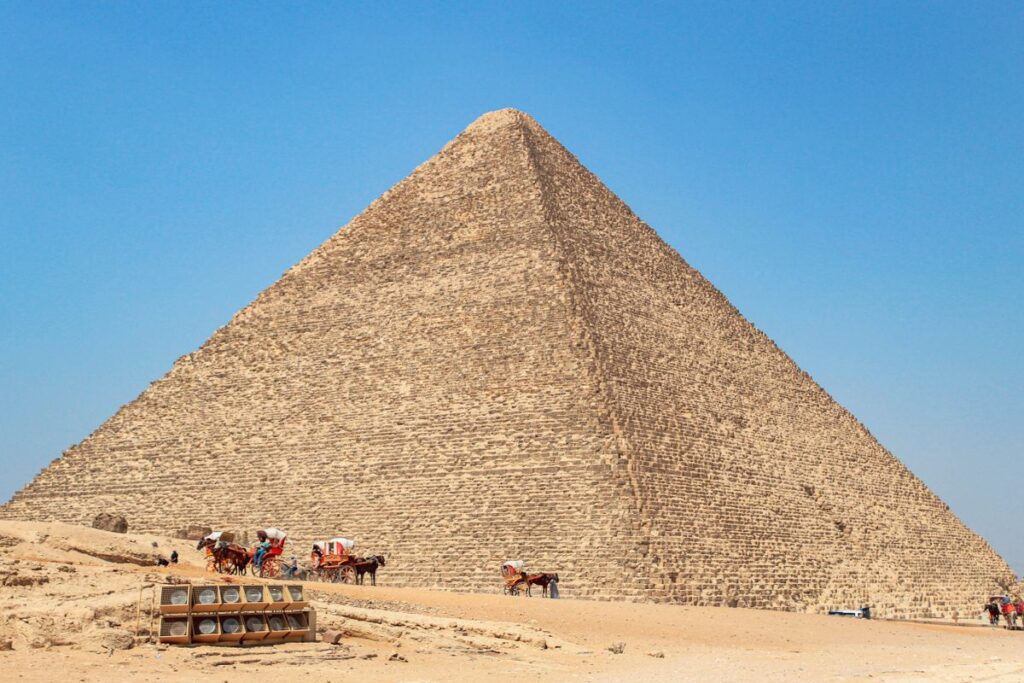
More than 4,500 years ago — long before the first universities existed — workers hauled over two million stone blocks into the desert west of the Nile and stacked them into a mountain 147 metres high. The Great Pyramid of Giza was the tallest human-made structure in the world for over 3,800 years, and it was essentially a tomb. The pyramids, pharaohs, and Nile-side villages of ancient Egypt still fascinate us because they answer a timeless question: what can an organized society achieve when it believes in something bigger than itself?
Why and how the pyramids were built
The pyramids were royal tombs. Egyptians believed the pharaoh became divine after death, and his body — and his burial place — had to last for eternity. Building on the Nile’s west bank was deliberate: the sun set in the west, the land of the dead.
The first pyramid was not smooth-sided. Around 2650 BCE, the architect Imhotep stacked six shrinking mastabas (flat-roofed tombs) for Pharaoh Djoser, creating the Step Pyramid at Saqqara — the earliest large stone building in Egypt. A century later, Khufu’s builders perfected the true pyramid at Giza: about 2.3 million limestone blocks assembled over roughly 20 years. Modern archaeology has settled the old slave-labour myth — the workforce was made of skilled Egyptian labourers, craftsmen, and seasonal farmers, fed, housed, and medically treated in workers’ settlements nearby. Ramps, sledges on wet sand, and brilliant logistics did what engines would do today.
The famous pharaohs
Egypt had over 170 pharaohs across 3,000 years, but a handful became legends.
Khufu (c. 2550 BCE)
Builder of the Great Pyramid at Giza — the largest of the three main pyramids and the only surviving Wonder of the Ancient World. At 147 metres, it stayed the world’s tallest structure for nearly four millennia.
Hatshepsut (c. 1479–1458 BCE)
One of history’s earliest successful female rulers. After her husband’s death she declared herself pharaoh, presiding over two decades of prosperity — her expedition to the Land of Punt brought back gold, ivory, and exotic trees.
Tutankhamun (c. 1332–1323 BCE)
The “boy king” who took the throne at about nine and died at nineteen. In 1922 Howard Carter found his tomb nearly intact, with the golden mask that is now the global icon of ancient Egypt.
Ramesses II (c. 1279–1213 BCE)
Ramesses the Great reigned 66 years, signed an early peace treaty with the Hittites, and built more monuments than any other pharaoh — including the rock temples of Abu Simbel.
Hieroglyphs: writing that became art
Egyptian writing used around 700 signs that worked as pictures, sounds, or both — hieroglyphs for monuments, plus simpler cursive scripts for daily paperwork. For over a thousand years after the last hieroglyph was carved, nobody could read them — until the Rosetta Stone, found in 1799. Carrying the same decree in hieroglyphs, demotic, and ancient Greek, it let Jean-François Champollion crack the code in 1822, unlocking 3,000 years of Egyptian records.
Daily life along the Nile
Beyond the monuments, Egypt was a civilization of farmers, bakers, weavers, and schoolchildren. The Nile’s annual flood laid rich black silt on the riverbanks, making farming so reliable that the calendar revolved around three seasons: flood, sowing, and harvest. Bread and beer were the staples — beer was a thick, nutritious drink consumed by children and workers alike — with onions, lentils, dates, figs, and fish.
Women enjoyed remarkable rights for the ancient world: they could own property, run businesses, and initiate divorce. Children played with wooden toys and senet, one of the oldest known board games. Most people lived in mud-brick houses and wore linen.
Religion and the afterlife
Egyptians worshipped a vast family of gods — Ra the sun god, Osiris the judge of the dead, Isis the protector — and believed death was a journey, not an end. The body had to be preserved through mummification: organs removed, the body dried with natron salt, wrapped in linen, and placed in decorated coffins. Tombs were stocked with food, furniture, and shabti figurines — servant statues meant to work for the deceased in the afterlife. In the “weighing of the heart” ceremony, a heart lighter than a feather of truth earned a blissful afterlife. This belief system is why so many Egyptian artifacts survive: they buried their finest work underground.
Egypt’s legacy today
Egypt’s influence runs deeper than museum displays. Its 365-day calendar became the basis of our own. Its medical texts describe diagnoses and surgical techniques modern doctors still recognize. In 1979, UNESCO listed “Memphis and its Necropolis” as a World Heritage Site. And Egyptology itself was born from the decipherment of hieroglyphs — proof that a single stone slab can reopen three millennia of human history.
References
- Britannica – Giza – the Great Pyramid’s construction, dimensions and history
- Britannica – Khufu – biography of the pharaoh who built the Great Pyramid
- Gresham College – The Rosetta Stone – discovery and decipherment of hieroglyphs
- Egypt Ministry of Tourism and Antiquities – Memphis and its Necropolis – official heritage guide
#AncientEgypt #History #Pyramids #Culture #Civilization
