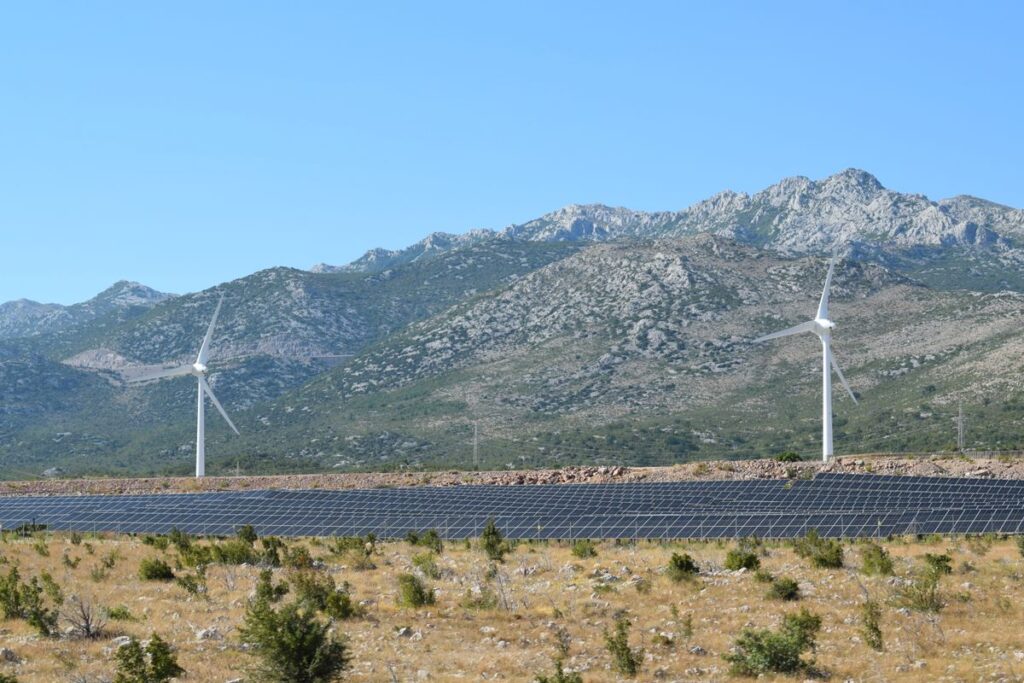
Open your phone’s battery settings on a sunny afternoon and you are looking at renewable energy in action — the same physics that charges a phone through a portable solar panel also powers entire cities. Renewable sources like sunlight, wind, and flowing water keep supplying power because nature keeps replenishing them, unlike coal or oil, which took millions of years to form. Here is a plain-language guide to how the main technologies work, why they matter for the climate, and what a student can do about them.
How solar panels turn sunlight into electricity
A solar panel is a flat box of small squares called photovoltaic (PV) cells, usually made of silicon — the same material inside computer chips. The process, the photovoltaic effect, works in three steps. First, sunlight arrives as tiny packets of energy called photons; when one strikes the cell, it knocks an electron loose from its atom. Second, the cell’s two silicon layers create an internal electric field — a one-way street that pushes every freed electron in the same direction, and millions of moving electrons are an electric current. Third, metal contacts collect that current and feed it into a wire.
Solar cells produce direct current (DC), but homes use alternating current (AC), so an inverter converts one to the other. Curiously, panels dislike extreme heat — efficiency drops slightly above 25°C, which is why they often perform best on cool, bright days. Most commercial panels convert 15–22% of sunlight into electricity, and that figure keeps rising.
How wind turbines harvest the air
A wind turbine is the opposite of a fan: instead of using electricity to make wind, it uses wind to make electricity. The blades work like airplane wings — when wind flows across a blade, air pressure drops on one side, creating lift that is stronger than the wind’s push (drag) against it. That difference spins the rotor, which drives a generator through a gearbox that steps rotation up from about 18 revolutions per minute to roughly 1,800.
Taller towers catch faster, steadier winds, which is why modern turbines stand 100 metres or more. A single large turbine can power more than a thousand homes. Wind is itself a form of solar energy: the sun heats the atmosphere unevenly, and that uneven heating creates the moving air we call wind.
Hydropower and geothermal in brief
Hydropower is the oldest renewable electricity source. A dam stores river water; released water flows downhill through a pipe called a penstock, spinning a turbine connected to a generator. Hydropower’s superpower: a dam can start generating within minutes, making it ideal backup when demand spikes.
Geothermal energy taps the Earth’s internal heat. In volcanic regions, steam near the surface spins turbines directly; elsewhere, deep wells bring heat up for power or heating buildings. Unlike solar and wind, geothermal runs day and night, in any weather — which is why Iceland, Norway, and Costa Rica rely on it so heavily.
Why renewables matter for the climate
Burning coal, oil, and gas releases carbon dioxide that traps heat in the atmosphere — the main driver of climate change. Solar panels and wind turbines produce no emissions during operation, and even counting manufacturing, their lifetime carbon footprint is a small fraction of fossil fuels’. Shifting electricity to renewables is the single fastest lever we have for cutting global emissions.
There is also a health angle that matters to students: fossil fuels cause air pollution linked to asthma and respiratory illness, while solar and wind keep local air clean. And because sunlight and wind are free, countries investing in renewables gain energy independence instead of importing fuel.
The storage challenge and how the grid works
The honest weakness of solar and wind is intermittency: the sun sets and the wind calms, yet the grid needs supply to match demand every second. Three solutions fill that gap. First, storage — lithium batteries, plus pumped-storage hydropower, which pumps water uphill with surplus electricity and releases it later. Second, smart grids: digital systems that shift flexible demand (charging electric buses, cooling warehouses) to times when renewable power is abundant. Third, geographic diversity: wind is always blowing somewhere, so strong transmission lines between regions smooth out local gaps.
What students can actually do
You do not need a policy degree to act. Start on campus: propose a solar audit of your university’s rooftops, join an environmental society, or volunteer for cleanup drives. Learn energy literacy: find out where your city’s power comes from.
Renewable energy is one of the fastest-growing job sectors in the world, spanning engineering, data analysis, and policy. A weekend course in solar installation or a final-year project on campus energy use can become a genuine career differentiator.
References
- U.S. Department of Energy – How Does Solar Work? – photovoltaic basics and solar technologies
- U.S. Department of Energy – How a Wind Turbine Works – lift, gearboxes and electricity generation
- U.S. Energy Information Administration – Hydropower Explained – dams, turbines and the water cycle
#RenewableEnergy #Solar #Sustainability #Environment #Climate
