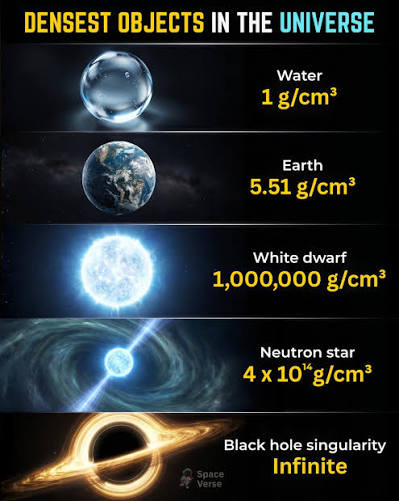
Among the most extraordinary objects in the universe are neutron stars. Born from the explosive deaths of massive stars, these incredibly dense remnants challenge our understanding of physics. Despite being only about the size of a city, a neutron star can contain more mass than our Sun, making it one of the densest known objects in existence.
What Is a Neutron Star?
A neutron star forms when a massive star exhausts its nuclear fuel and explodes in a supernova. During this violent event, gravity compresses the star’s core so intensely that protons and electrons combine to form neutrons.
The result is an object only about 20 kilometers (12 miles) across but with a mass greater than that of the Sun.
Incredible Density
Neutron stars are almost unimaginably dense.
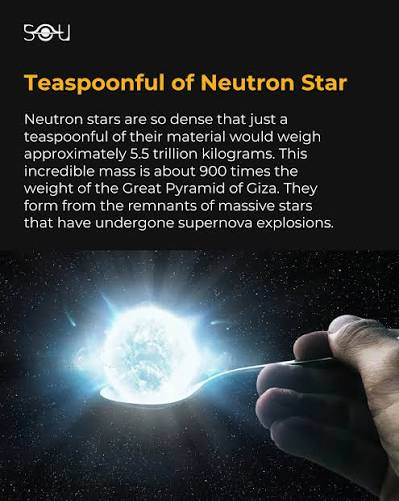
A single teaspoon of neutron star material would weigh billions of tons on Earth. This incredible density means gravity on the surface is billions of times stronger than Earth’s gravity.
If a person could somehow stand on a neutron star—which is impossible—they would be crushed instantly by its immense gravitational force.
Layers of a Neutron Star
Scientists believe neutron stars have several distinct layers.
The outer crust consists of tightly packed atomic nuclei and electrons. Beneath the crust lies an inner region where matter becomes increasingly compressed.
At the core, matter exists under pressures and densities impossible to reproduce in laboratories on Earth. Researchers are still debating exactly what exists there. Some theories suggest exotic particles or even free quarks may be present.
Pulsars: Cosmic Lighthouses
Many neutron stars rotate extremely rapidly while emitting beams of radio waves, X-rays, or gamma rays from their magnetic poles.
As these beams sweep across Earth, they appear as regular pulses, leading scientists to call these objects pulsars. Some rotate hundreds of times every second while maintaining extraordinary precision, making them valuable tools for studying gravity and testing theories of physics.
Magnetic Giants
Certain neutron stars, known as magnetars, possess the strongest magnetic fields ever observed in the universe.
Their magnetic fields are trillions of times stronger than Earth’s. Occasionally, magnetars release powerful bursts of high-energy radiation that can be detected across vast distances in space.
Why Scientists Study Neutron Stars
Neutron stars provide a natural laboratory for studying matter under extreme conditions.
They help scientists better understand nuclear physics, gravity, and the behavior of matter at densities impossible to create on Earth. Observations of neutron star collisions have also revealed how many heavy elements, including gold and platinum, are formed in the universe.
Modern Discoveries
Powerful telescopes and gravitational-wave observatories have transformed neutron star research. By detecting collisions between neutron stars, scientists can observe both gravitational waves and electromagnetic radiation from the same event, providing unprecedented insights into the evolution of the universe.
Future observatories are expected to reveal even more about these remarkable cosmic objects.
Conclusion
Neutron stars are among the universe’s most astonishing creations. Their immense density, powerful magnetic fields, and rapid rotation continue to challenge scientists and expand our understanding of the laws of physics. As new technologies improve our ability to observe deep space, neutron stars will remain one of the star.