For decades, Mars has been the ultimate destination for human space exploration. However, scientists and space agencies are already looking beyond the Red Planet toward even more ambitious missions. As technology advances, humanity’s future in space may include journeys to distant moons, asteroid colonies, and eventually the stars. While these goals remain challenging, they represent the next great chapter in human exploration.
Why Go Beyond Mars?
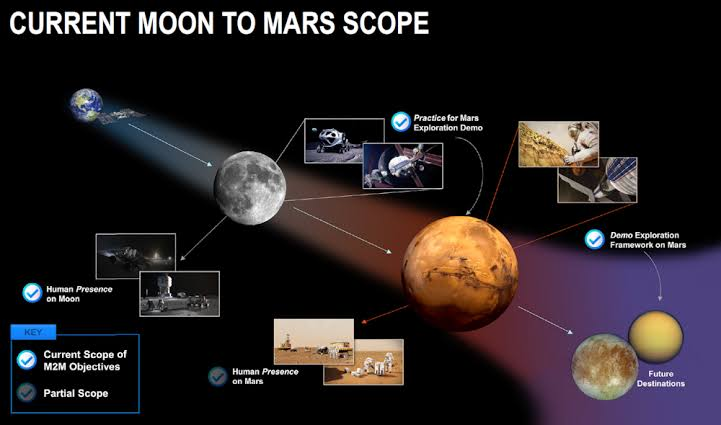
Mars is considered a stepping stone rather than the final destination. By establishing a human presence on Mars, scientists hope to gain valuable experience in long-duration space travel, resource management, and extraterrestrial living. These lessons will prepare future explorers for even longer missions across the solar system.
Exploring beyond Mars could answer important scientific questions about the origins of the solar system, the possibility of life elsewhere, and the availability of valuable natural resources.
Promising Destinations
Jupiter’s Moons
Several of Jupiter’s moons are considered exciting targets for future exploration. Europa, in particular, is believed to have a vast ocean beneath its icy surface. Scientists think this hidden ocean could contain conditions suitable for microbial life.
Saturn’s Moon Titan
Titan is one of the most fascinating places in the solar system. It has a thick atmosphere, rivers, lakes, and weather systems, although its lakes are made of liquid methane and ethane rather than water. Future robotic and eventually human missions could reveal whether Titan holds clues to the chemistry that led to life on Earth.
Asteroid Exploration
Asteroids contain valuable minerals such as nickel, iron, platinum, and rare metals. Future missions may establish mining operations that provide materials for spacecraft construction and fuel production in space, reducing the need to launch everything from Earth.
New Technologies Driving Exploration
Human missions beyond Mars will depend on revolutionary technologies.
Advanced propulsion systems may dramatically reduce travel time across the solar system. Nuclear-powered spacecraft, electric propulsion, and future fusion technologies are being studied to make long-distance travel more practical.
Artificial intelligence will assist astronauts by managing spacecraft systems, analyzing scientific data, and supporting autonomous operations during communication delays with Earth.
Improved life-support systems will recycle air, water, and waste efficiently, enabling astronauts to survive during missions lasting several years.
Challenges Ahead
Traveling beyond Mars presents enormous obstacles.
The vast distances require spacecraft capable of operating reliably for years. Astronauts must also withstand prolonged exposure to cosmic radiation, muscle loss caused by microgravity, and the psychological effects of long-term isolation.
Reliable communication becomes increasingly difficult as spacecraft travel farther from Earth, creating delays that prevent real-time conversations with mission control.
Developing sustainable habitats, medical technologies, and emergency response systems will be essential for future success.
International Cooperation
The future of deep-space exploration will likely depend on collaboration between nations. Space agencies, universities, and private aerospace companies are increasingly working together to develop advanced technologies and share scientific knowledge.
International partnerships can reduce costs, combine expertise, and accelerate innovation while promoting peaceful exploration of space.
Could Humans Reach Another Star?
Although interstellar travel remains beyond current technological capabilities, scientists continue exploring concepts such as laser-powered spacecraft, fusion propulsion, and generation ships that could one day carry humans to nearby star systems.
While these missions may take many decades or even centuries to achieve, today’s research lays the foundation for tomorrow’s discoveries.
Conclusion
Human missions beyond Mars represent one of humanity’s greatest ambitions. Advances in engineering, robotics, artificial intelligence, and space science are steadily bringing these dreams closer to reality. As explorers venture farther into the solar system and eventually beyond, each mission will expand our understanding of the universe and inspire future generations to continue reaching for the stars.