Introduction
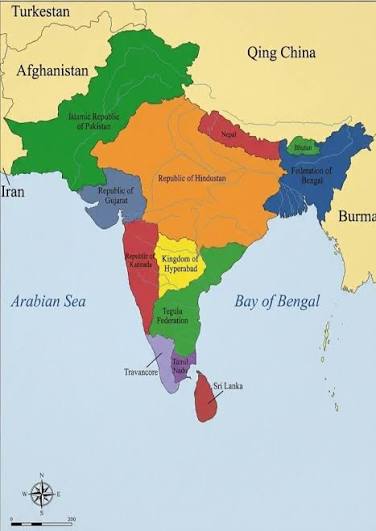
The Indian subcontinent is a vast geographical region that includes present-day India, Pakistan, Bangladesh, Nepal, Bhutan, and parts of Afghanistan and Sri Lanka. Before 1800, the subcontinent was home to some of the world’s oldest civilizations and powerful empires. It was known for its rich culture, advanced education, flourishing trade, and remarkable achievements in art, architecture, science, and literature.
Early Civilizations
The history of the subcontinent began with the Indus Valley Civilization around 3300 BCE. Major cities such as Harappa and Mohenjo-daro had well-planned streets, drainage systems, and advanced urban development. The people practiced agriculture, trade, and craftsmanship.
Ancient Kingdoms and Empires
After the decline of the Indus Valley Civilization, several kingdoms emerged across the region. One of the most powerful was the Maurya Empire (322–185 BCE), founded by Chandragupta Maurya. His grandson, Ashoka, promoted peace, justice, and the spread of Buddhism.
Later, the Gupta Empire (c. 320–550 CE) became known as the “Golden Age of India” because of its achievements in mathematics, astronomy, medicine, literature, and art.
Arrival of Islam
From the 8th century onward, Muslim traders and rulers arrived in the subcontinent. The establishment of the Delhi Sultanate in the 13th century introduced new systems of administration, architecture, language, and culture. Trade and cultural exchanges increased during this period.
The Mughal Empire
One of the greatest empires before 1800 was the Mughal Empire, founded by Babur in 1526. Under rulers such as Akbar, Jahangir, Shah Jahan, and Aurangzeb, the empire expanded and became one of the wealthiest in the world.
The Mughals built magnificent monuments, including the Taj Mahal, forts, gardens, and mosques. They also encouraged literature, painting, music, and architecture.
Economy and Trade
Before 1800, the subcontinent had a strong agricultural economy. Farmers grew crops such as rice, wheat, cotton, and sugarcane. Indian textiles, spices, silk, and precious stones were exported to Europe, the Middle East, and Southeast Asia. Important trade routes connected the region with many parts of the world.
Society and Culture
The subcontinent was home to diverse religions, languages, and cultures. Hinduism, Buddhism, Jainism, Islam, and Sikhism all contributed to its rich cultural heritage. Education flourished in schools, temples, mosques, and centers of learning. Literature, poetry, music, and traditional arts developed significantly during this period.
Political Changes Before 1800
By the late 18th century, the Mughal Empire had weakened due to internal conflicts, regional powers, and foreign invasions. At the same time, the British East India Company expanded its political and military influence through trade, alliances, and wars. This marked the beginning of British dominance in the Indian subcontinent.
References
- A History of India.
- India: A History.
- Encyclopaedia Britannica.
